Snuff Container (1800s–1900s): Art, History and Details
Snuff Container at the Cleveland Museum of Art: 1800s–1900s, Gourd and copper alloy. Explore the work's context, creator attribution and collection history.
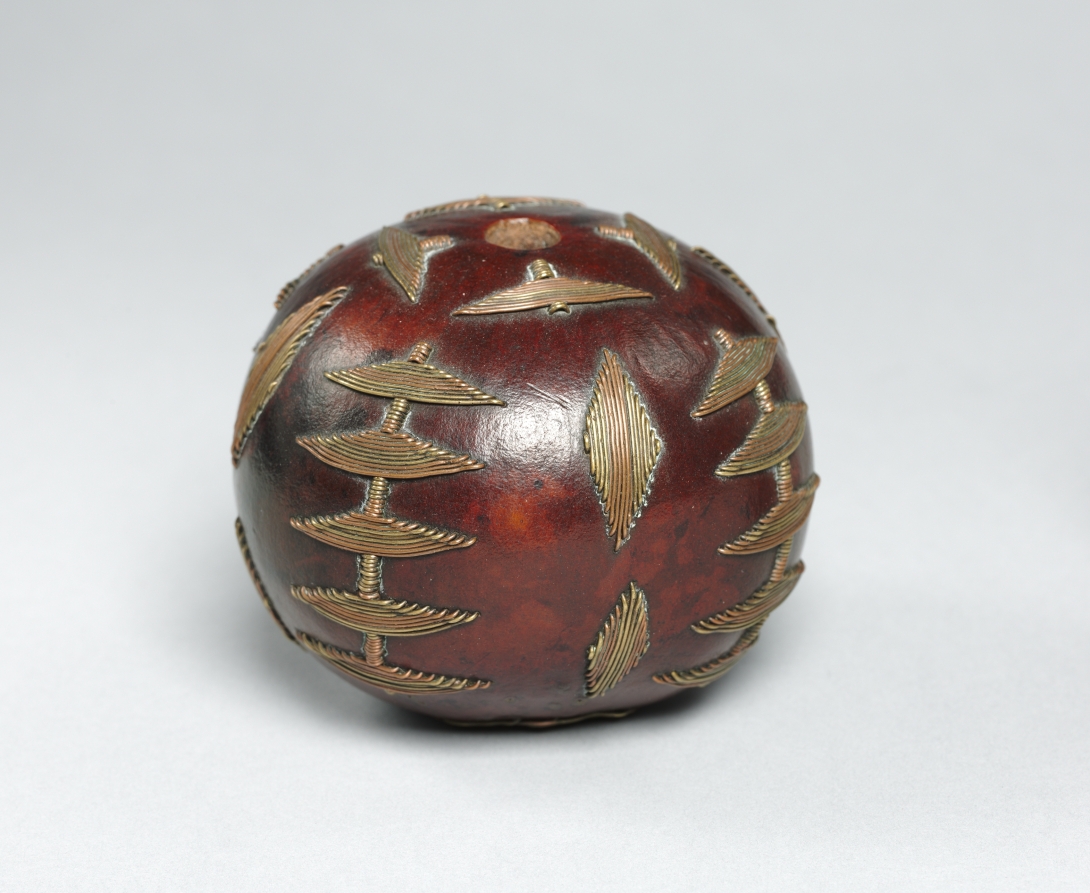
Snuff Container (1800s–1900s) is in the Cleveland Museum of Art collection.
The work and its context
The museum's open-access catalogue describes the work:
The shape and material of gourd snuff containers—like a woman’s womb, the gourd contains and nurtures the seed—suggest they were made for female users and allude to procreation and fecundity.
Object facts
- Title: Snuff Container
- Date: 1800s–1900s
- Culture: Africa, Southern Africa, South Africa, Zimbabwe or Mozambique, Northern Nguni-style or Shona-style maker
- Type: Vessels
- Technique: Gourd and copper alloy
- Dimensions: Overall: 7.5 cm (2 15/16 in.)
- Collection: African Art
- Department: African Art
- Accession number: 2010.200
A detail from the museum
The snuff and tobacco held in this container were believed to enable communication between humans and ancestors.
Collection credit
Leonard C. Hanna Jr. Fund
Further reading listed by the museum
- Klopper, Sandra. The Zulu Kingdom. New York: Rosen Publishing Group and Franklin Watts Library Edition (First Books on African Civilizations), 1998, cover; Ginzberg, Marc. African Forms, exh. cat., Museum for African Art, New York. Milan: Skira, 2000, p. 120; Sotheby's. "Collection Marc et Denyse Ginzberg." Paris, Sept. 10, 2007, lot 96
View the collection record
See the museum's photographs and full catalogue entry. Catalogue text is reproduced from the Cleveland Museum of Art's open-access data, with HTML formatting removed. This object and its supplied image are designated CC0.
Sources
More in Lifestyle
Keep reading


