Spatula with Carved Lizard (100 BCE–700 CE): Art, History and Details
Spatula with Carved Lizard at the Cleveland Museum of Art: 100 BCE–700 CE, bone with shell inlay. Explore the work's context, creator attribution and collection history.
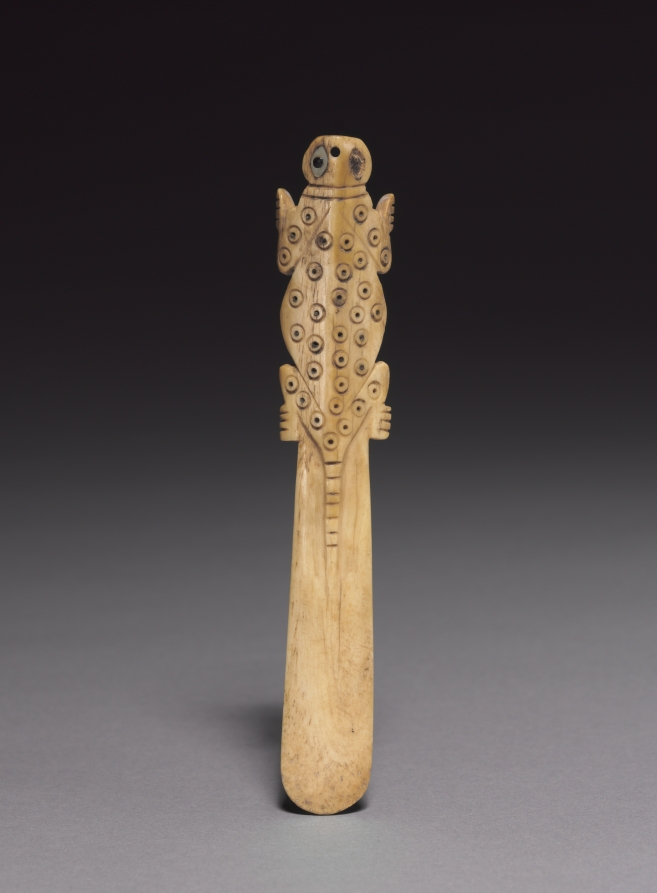
Spatula with Carved Lizard (100 BCE–700 CE) is in the Cleveland Museum of Art collection.
The work and its context
The museum's open-access catalogue describes the work:
Peruvian Indians today regard coca leaf as a sacred substance that creates communion with supernatural forces. The leaves are chewed with powdered lime that in antiquity was stored in containers and scooped with spatulas like those seen here. Aside from its ritual meaning, coca has practical benefits: it is vitamin-rich; like coffee, it induces clear-headedness; and it increases stamina. The lizard spatula is Nasca in style.
Object facts
- Title: Spatula with Carved Lizard
- Date: 100 BCE–700 CE
- Culture: Peru, South Coast, Nasca
- Type: Sculpture
- Technique: bone with shell inlay
- Dimensions: Overall: 11.8 x 2.6 cm (4 5/8 x 1 in.)
- Collection: AA - Andes
- Department: Art of the Americas
- Accession number: 1955.83
Collection credit
Purchase from the J. H. Wade Fund
View the collection record
See the museum's photographs and full catalogue entry. Catalogue text is reproduced from the Cleveland Museum of Art's open-access data, with HTML formatting removed. This object and its supplied image are designated CC0.
Sources
More in Lifestyle
Keep reading