Spear Thrower (200 BCE–200 CE): Art, History and Details
Spear Thrower at the Cleveland Museum of Art: 200 BCE–200 CE, bone, hematite, cotton thread, sinew. Explore the work's context, creator attribution and collection history.
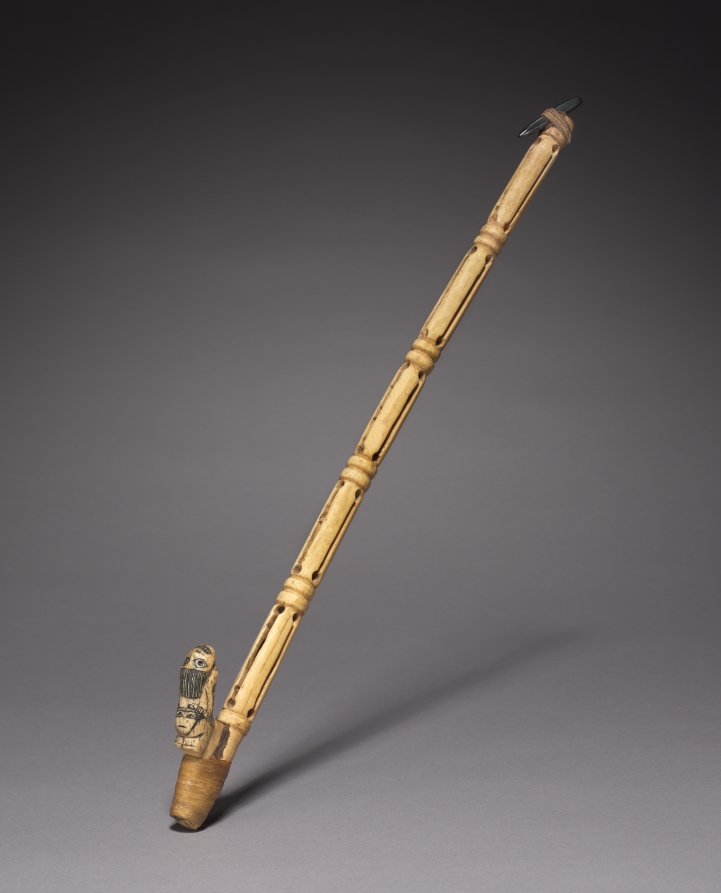
Spear Thrower (200 BCE–200 CE) is in the Cleveland Museum of Art collection.
The work and its context
The museum's open-access catalogue describes the work:
Spear throwers improve a spear's range and thrust. The spear was placed against the stone pivot and hurled using the thumb rest, carved as a figure with a skeletal chest, back-bent head, and a severed human head at its rear. This figure, frequent in art, is not well understood, but its appearance here suggests a connection to death. The shaft's carving makes clever use of the bone's marrow cavity.
Object facts
- Title: Spear Thrower
- Date: 200 BCE–200 CE
- Culture: Peru, South Coast, late Paracas or early Nasca style
- Type: Arms and Armor
- Technique: bone, hematite, cotton thread, sinew
- Dimensions: Overall: 5.8 x 2 cm (2 5/16 x 13/16 in.)
- Collection: AA - Andes
- Department: Art of the Americas
- Accession number: 1940.507
A detail from the museum
Spear throwers, also called atlatls, use leverage to propel a spear faster and farther through the air.
Collection credit
The Norweb Collection
Further reading listed by the museum
- Ubbelohde-Doering, Heinrich. The Art of Ancient Peru. New York: F.A. Praeger, 1952.
- Cleveland Museum of Art. The CMA Companion: A Guide to the Cleveland Museum of Art. Cleveland: Cleveland Museum of Art, 2014.
View the collection record
See the museum's photographs and full catalogue entry. Catalogue text is reproduced from the Cleveland Museum of Art's open-access data, with HTML formatting removed. This object and its supplied image are designated CC0.
Sources
More in Lifestyle
Keep reading