Spoon with Saint Paul as an Athlete (350–400): Art, History and Details
Spoon with Saint Paul as an Athlete at the Cleveland Museum of Art: 350–400, silver, silver gilt, and niello. Explore the work's context, creator attribution and collection history.
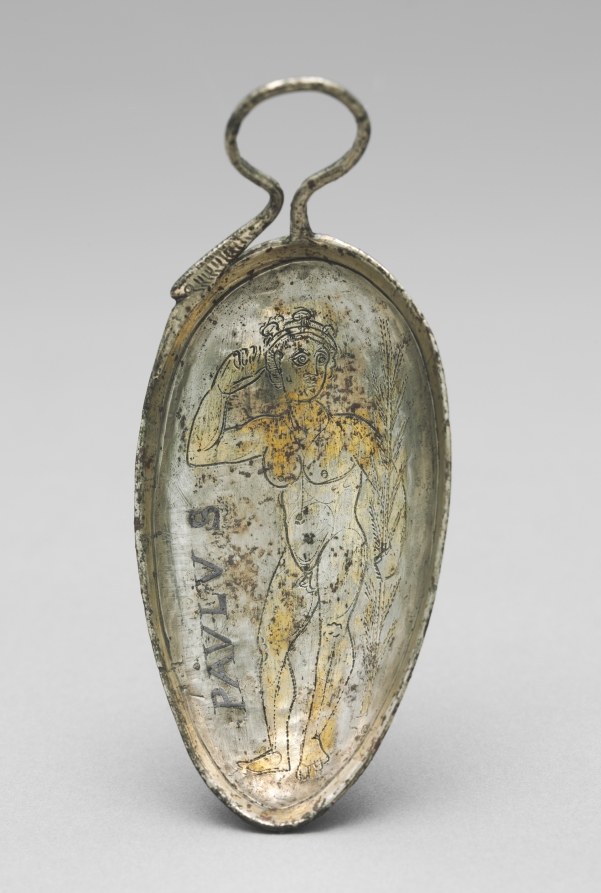
Spoon with Saint Paul as an Athlete (350–400) is in the Cleveland Museum of Art collection.
The work and its context
The museum's open-access catalogue describes the work:
Silver spoons with swan neck handles (ligulae) were popular in the Late Roman Empire. This late antique spoon is unique because it is decorated with the nude figure of a victorious athlete identified in an inscription as PAVLVS (Paul). It is tempting to interpret the juxtaposition of the name with a classical representation of an athlete as a subtle allusion to a passage in Saint Paul’s first letter to the Corinthians (1 Cor. 9:24-27), in which the apostle characterizes himself as an "athlete of Christ." While this interpretation may imply that the spoon’s owner was a Christian, it does not imply a religious function for the object, which was likely used for display or fine dining.
Object facts
- Title: Spoon with Saint Paul as an Athlete
- Date: 350–400
- Culture: late Roman Empire, perhaps Syria, early Byzantine, 4th century
- Type: Metalwork
- Technique: silver, silver gilt, and niello
- Dimensions: Overall: 4.6 x 5.6 cm (1 13/16 x 2 3/16 in.)
- Collection: MED - Byzantine
- Department: Medieval Art
- Accession number: 1964.39
Collection credit
John L. Severance Fund
Further reading listed by the museum
- The Cleveland Museum of Art. Handbook of the Cleveland Museum of Art/1966. Cleveland, OH: The Cleveland Museum of Art, 1966.
- The Cleveland Museum of Art. Handbook of the Cleveland Museum of Art/1969. Cleveland, OH: The Cleveland Museum of Art, 1969.
- Wixom, William D. “A Mystery Spoon from the Fourth Century.” The Bulletin of the Cleveland Museum of Art 57, no. 5 (May 1970): 141–148.
View the collection record
See the museum's photographs and full catalogue entry. Catalogue text is reproduced from the Cleveland Museum of Art's open-access data, with HTML formatting removed. This object and its supplied image are designated CC0.
Sources
More in Lifestyle
Keep reading