Spread with floral medallion pattern (1700s): Art, History and Details
Spread with floral medallion pattern at the Cleveland Museum of Art: 1700s, Cotton: plain weave, quilted; silk and gilt-metal thread: embroidery, couched laid work. Explore the work's context, creator attribution and collection history.
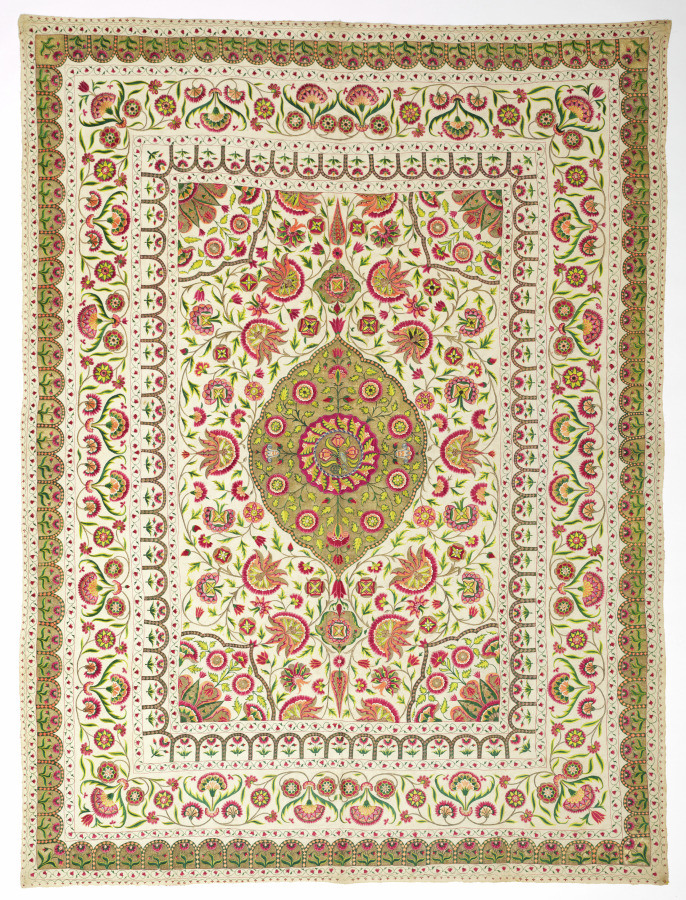
Spread with floral medallion pattern (1700s) is in the Cleveland Museum of Art collection.
The work and its context
The museum's open-access catalogue describes the work:
This textile could have been used as a covering for seating on the floor or as a bedspread in either an Indian or European setting. In any case, it was not meant to be walked on. Its material and imagery testify to flourishing international relationships. The arabesque designs, consisting of swirling vines with large and small flowers, recall a radiant paradise and have roots in Persian, Chinese, and Mediterranean sources. The use of gold-wrapped thread had been widespread in Spain and Portugal before it was adopted in India, probably first in Goa, a Portuguese colony on the southwestern coast of India from 1510 to 1961. The vibrant colors are distinctive to this region of India.
Object facts
- Title: Spread with floral medallion pattern
- Date: 1700s
- Culture: Mughal India, Deccan, probably Goa
- Type: Embroidery
- Technique: Cotton: plain weave, quilted; silk and gilt-metal thread: embroidery, couched laid work
- Dimensions: Overall: 251.5 x 330.2 cm (99 x 130 in.)
- Collection: T - Islamic
- Department: Textiles
- Accession number: 1916.1359
A detail from the museum
A small blue and yellow bird perches at the center of the otherwise solely floral design.
Collection credit
Gift of Mr. and Mrs. J. H. Wade
Further reading listed by the museum
- Jain, Rahul. Rapture: The Art of Indian Textiles. New Delhi: Niyogi Books, 2011.
- Mackie, Louise W. Symbols of Power: Luxury Textiles from Islamic Lands, 7th-21st Century. Cleveland: Cleveland Museum of Art, 2015.
View the collection record
See the museum's photographs and full catalogue entry. Catalogue text is reproduced from the Cleveland Museum of Art's open-access data, with HTML formatting removed. This object and its supplied image are designated CC0.
Sources
More in Lifestyle
Keep reading