Square Shawl ("amli") (mid-1800s): Art, History and Details
Square Shawl ("amli") at the Cleveland Museum of Art: mid-1800s, Wool: embroidery (large-pieced areas). Explore the work's context, creator attribution and collection history.
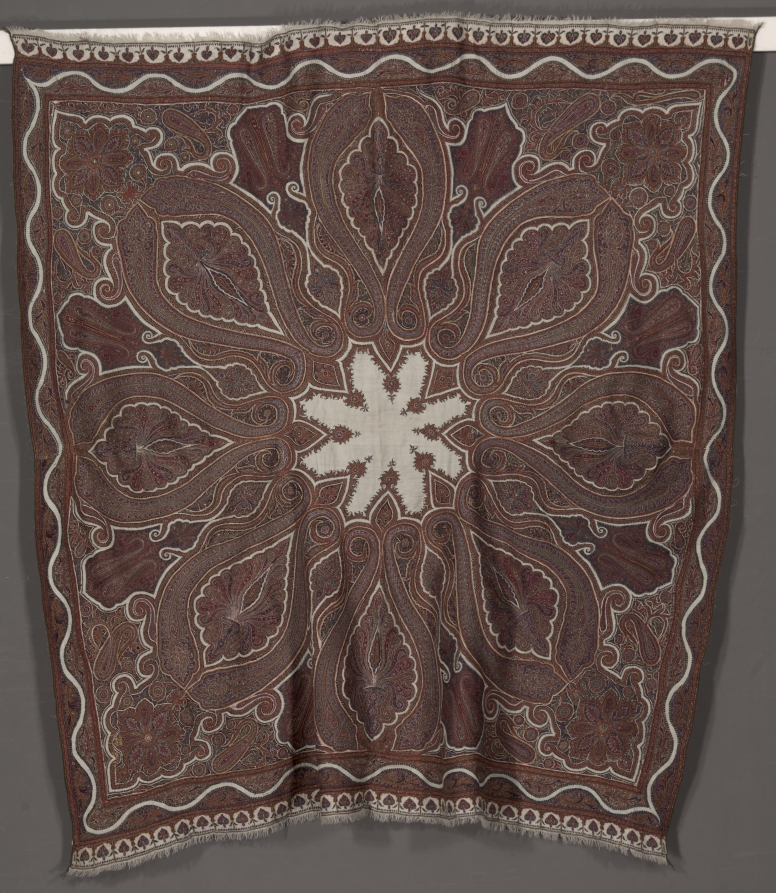
Square Shawl ("amli") (mid-1800s) is in the Cleveland Museum of Art collection.
The work and its context
The museum's open-access catalogue describes the work:
The central white medallion radiates into a swirling pattern of rosettes and teardrop-shaped “tree-of-life” motifs, also known as paisley, that spread over the entire surface. In the border is an undulating vine and a row of gate-like elements filled with individual trees. Kashmiri shawls were signs of high social status in India. Beginning in the late 1700s, the shawls were also coveted throughout Europe and America, until they began to fall out of fashion during the 1870s.
Object facts
- Title: Square Shawl ("amli")
- Date: mid-1800s
- Culture: India, Kashmir
- Type: Embroidery
- Technique: Wool: embroidery (large-pieced areas)
- Dimensions: Overall: 182.9 x 177.8 cm (72 x 70 in.)
- Collection: Textiles
- Department: Textiles
- Accession number: 1926.239
Collection credit
Gift of the Burridge Family
View the collection record
See the museum's photographs and full catalogue entry. Catalogue text is reproduced from the Cleveland Museum of Art's open-access data, with HTML formatting removed. This object and its supplied image are designated CC0.
Sources
More in Lifestyle
Keep reading