St. Anthony Falls from Across the River (c. 1853–54): Art, History and Details
St. Anthony Falls from Across the River at the Cleveland Museum of Art: c. 1853–54, daguerreotype, half-plate. Explore the work's context, creator attribution and collection history.
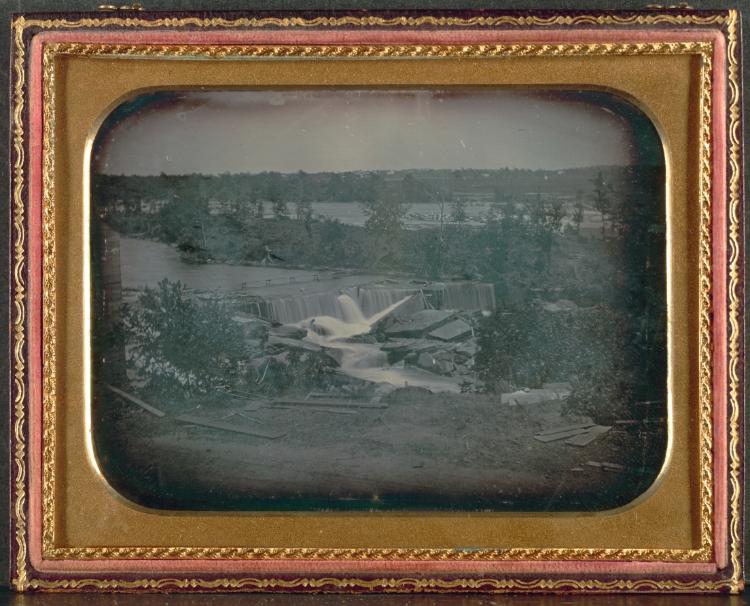
St. Anthony Falls from Across the River (c. 1853–54) is in the Cleveland Museum of Art collection.
The work and its context
The museum's open-access catalogue describes the work:
In this image of St. Anthony Falls, the unidentified daguerreotypist made an "instantaneous view" of a remarkable natural wonder, rendering its specific geological formation with exacting clarity. Above a narrow channel where the Mississippi River runs between steep bluffs in Minneapolis, Minnesota, the falls churns away at the bedrock over which it descends. Named by Father Louis Hennepin during his travels in 1680, it is the only significant waterfall on the entire Mississippi River. The specific motivations of the photographer remain unknown. He or she may have wished the photograph to be scientific and documentary, a valuable visual aid for an artist, or just a reminder to a curious resident. No doubt, this daguerreotype was a rare image of the environment's unspoiled condition before the mid 1850s, when demand for an inexpensive energy source irreparably changed this area from a natural to industrial landscape.
Object facts
- Title: St. Anthony Falls from Across the River
- Date: c. 1853–54
- Culture: America
- Type: Photograph
- Technique: daguerreotype, half-plate
- Dimensions: Image: 10.8 x 16.5 cm (4 1/4 x 6 1/2 in.); Case: 12 x 15.3 cm (4 3/4 x 6 in.); Matted: 50.8 x 61 cm (20 x 24 in.)
- Collection: PH - American 19th Century
- Department: Photography
- Accession number: 2002.40
Collection credit
John L. Severance Fund
View the collection record
See the museum's photographs and full catalogue entry. Catalogue text is reproduced from the Cleveland Museum of Art's open-access data, with HTML formatting removed. This object and its supplied image are designated CC0.
Sources
More in Lifestyle
Keep reading