St. Francis Beneath a Tree Praying (1657): Art, History and Details
St. Francis Beneath a Tree Praying at the Cleveland Museum of Art: 1657, drypoint and etching. Explore the work's context, creator attribution and collection history.
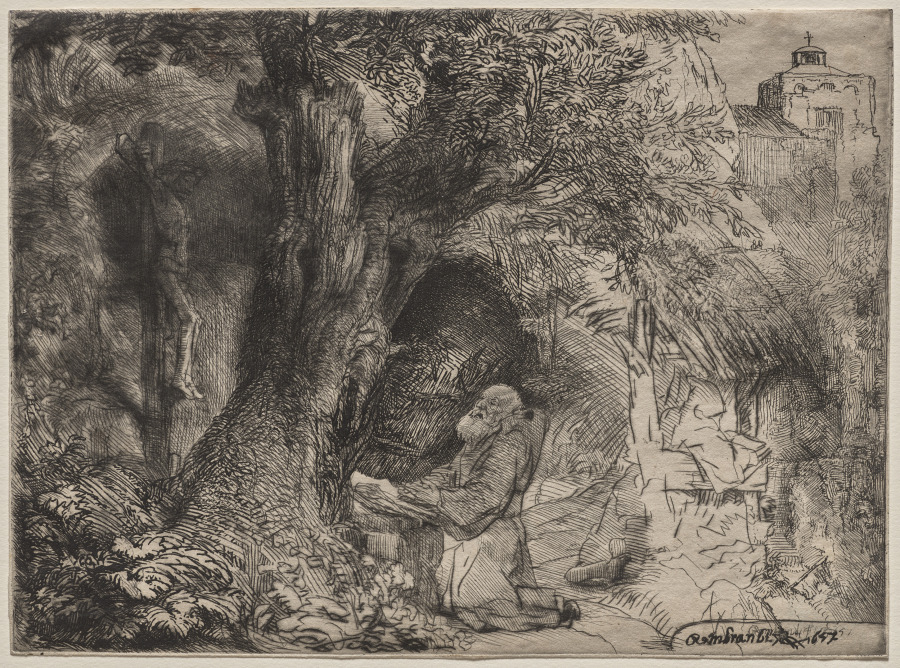
St. Francis Beneath a Tree Praying (1657) is in the Cleveland Museum of Art collection. The museum's creator attribution is Rembrandt van Rijn (Dutch, 1606–1669).
The work and its context
The museum's open-access catalogue describes the work:
One of Rembrandt’s most spiritually moving works, this drypoint and etching depicts a hermit saint sequestered in the wilderness and praying to a crucifix. A second figure on the right, a monk in bare outline, helps to identify the saint as Francis, who traveled with a friar named Brother Leo. Rembrandt focused on the lush, moody landscape surrounding the crucifix, creating space to the right of the composition by portraying a distant hill and structure. These compositional strategies reveal his knowledge of Venetian landscapes by Titian and others, which he had studied through prints and drawings. But while Rembrandt certainly looked to Italian art for inspiration and ideation, he always transformed what he saw into something distinctive and undeniably of his own invention, infused with the emotion and humanity that we see, for example, on the saint’s active face.
Object facts
- Title: St. Francis Beneath a Tree Praying
- Date: 1657
- Creator attribution: Rembrandt van Rijn (Dutch, 1606–1669)
- Culture: Netherlands
- Type: Print
- Technique: drypoint and etching
- Dimensions: Sheet: 18.1 x 24.5 cm (7 1/8 x 9 5/8 in.)
- Collection: PR - Drypoint
- Department: Prints
- Accession number: 2024.64
A detail from the museum
Always experimental, Rembrandt created this print by first sketching in the composition with drypoint and then adding etching in a second stage, which reversed his typical process.
Collection credit
Leonard C. Hanna Jr. Fund
View the collection record
See the museum's photographs and full catalogue entry. Catalogue text is reproduced from the Cleveland Museum of Art's open-access data, with HTML formatting removed. This object and its supplied image are designated CC0.
Sources
More in Lifestyle
Keep reading