St. Rocco Waterfall and Bridge at Tivoli (Cascata e Ponte di St. Rocco a Tivoli) (1795): Art, History and Details
St. Rocco Waterfall and Bridge at Tivoli (Cascata e Ponte di St. Rocco a Tivoli) at the Cleveland Museum of Art: 1795, etching in brown ink. Explore the work's context, creator attribution and collection history.
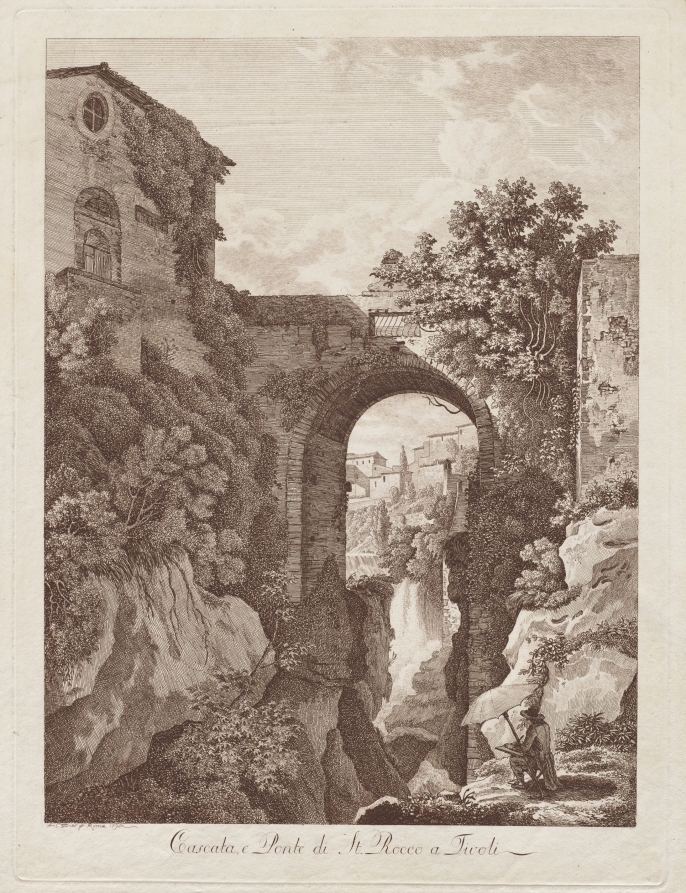
St. Rocco Waterfall and Bridge at Tivoli (Cascata e Ponte di St. Rocco a Tivoli) (1795) is in the Cleveland Museum of Art collection. The museum's creator attribution is Albert Christoph Dies (Austrian, 1755–1822).
The work and its context
The museum's open-access catalogue describes the work:
Throughout the latter part of the 18th century, successive generations of German artists visited Italy in order to study the acknowledged masterpieces of antiquity and the Renaissance. After an unsatisfactory initial course of study of printmaking in Basel, Dies set out on foot to Rome where he remained for twenty years working as a painter and etcher. This etching of an artist sketching a picturesque view at Tivoli came from a series of Italian views. Although at the time Dies’s work was criticized for being executed too freely, this composition articulates the Romantic landscapist’s bond with nature that dominated 19th-century German art.
Object facts
- Title: St. Rocco Waterfall and Bridge at Tivoli (Cascata e Ponte di St. Rocco a Tivoli)
- Date: 1795
- Creator attribution: Albert Christoph Dies (Austrian, 1755–1822)
- Culture: Austria
- Type: Print
- Technique: etching in brown ink
- Dimensions: Sheet: 39.9 x 30.7 cm (15 11/16 x 12 1/16 in.); Platemark: 36.8 x 27.5 cm (14 1/2 x 10 13/16 in.)
- Collection: PR - Etching
- Department: Prints
- Accession number: 2002.105
Collection credit
Gift of Susan Schulman in memory of Fred Schmidt
View the collection record
See the museum's photographs and full catalogue entry. Catalogue text is reproduced from the Cleveland Museum of Art's open-access data, with HTML formatting removed. This object and its supplied image are designated CC0.
Sources
More in Lifestyle
Keep reading