Standing Buddha (1100s): Art, History and Details
Standing Buddha at the Cleveland Museum of Art: 1100s, gold repoussé. Explore the work's context, creator attribution and collection history.
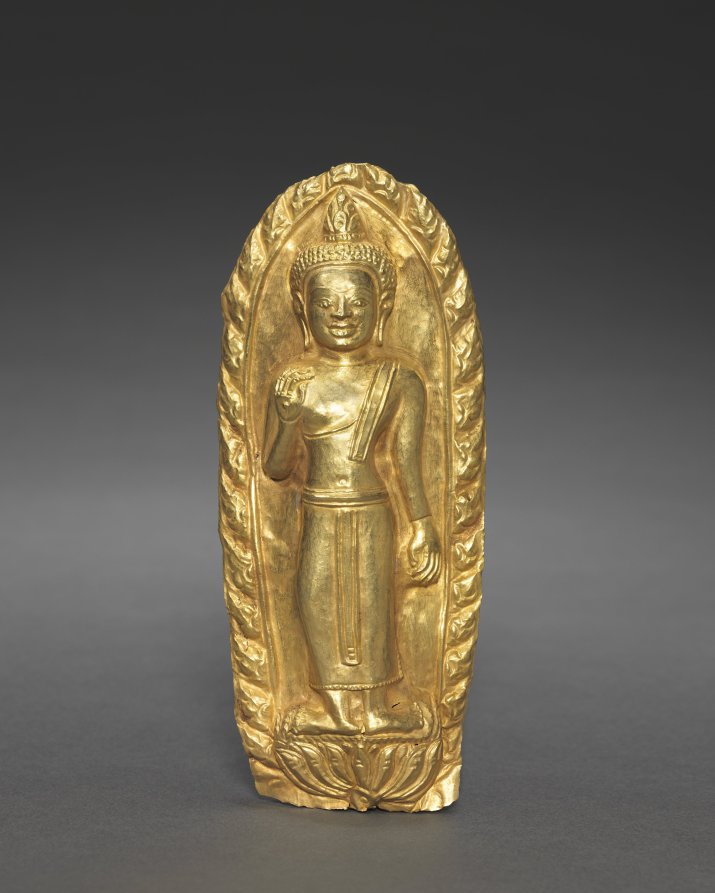
Standing Buddha (1100s) is in the Cleveland Museum of Art collection.
The work and its context
The museum's open-access catalogue describes the work:
Along with manuscripts, small-scale images of the Buddha could be commissioned by pilgrims or devotees and offered to a monastery in connection with a vow or the consecration of a sacred monument or object. The Buddha stands on a lotus flower that indicates his transcendence above ordinary beings. He is surrounded by flames that communicate his radiance and the intensity of the heat or power he acquired through meditation and discipline. His hands are in the mudra communicating the transmission of the teachings.
Object facts
- Title: Standing Buddha
- Date: 1100s
- Culture: Southern Myanmar (Burma), Pegu, or northwestern Thailand
- Type: Metalwork
- Technique: gold repoussé
- Dimensions: Overall: 13.8 x 5.7 cm (5 7/16 x 2 1/4 in.)
- Collection: Burmese Art
- Department: Indian and Southeast Asian Art
- Accession number: 1987.154
A detail from the museum
Pegu, the capital of the Mon empire, is on the south-central coast of Myanmar.
Collection credit
Gift of Maxine and Morris Stone
Further reading listed by the museum
- Turner, Evan H. “The Year in Review for 1987.” The Bulletin of the Cleveland Museum of Art 75, no. 2 (1988): 30–71.
- Menzies, Jackie. Buddha: Radiant Awakening. Sydney: Art Gallery NSW, 2001.
View the collection record
See the museum's photographs and full catalogue entry. Catalogue text is reproduced from the Cleveland Museum of Art's open-access data, with HTML formatting removed. This object and its supplied image are designated CC0.
Sources
More in Lifestyle
Keep reading