Standing Buddha (150–200 CE): Art, History and Details
Standing Buddha at the Cleveland Museum of Art: 150–200 CE, schist. Explore the work's context, creator attribution and collection history.
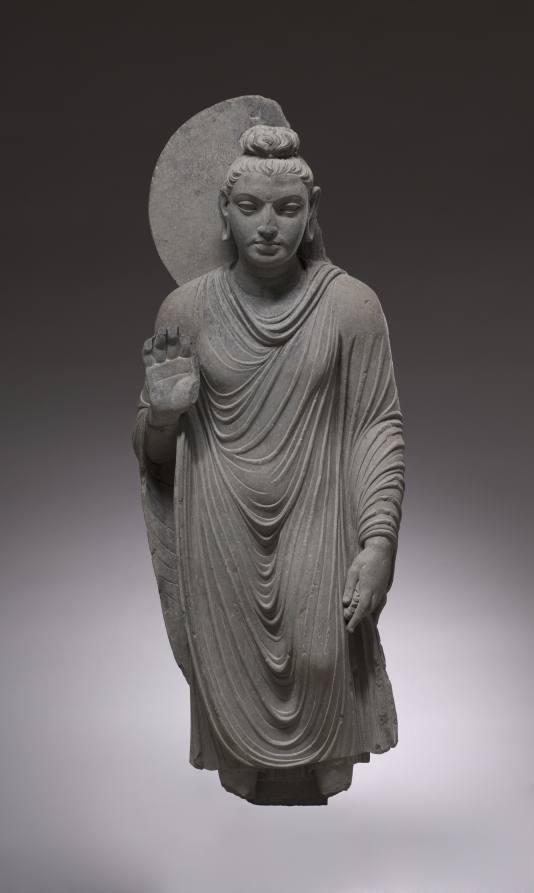
Standing Buddha (150–200 CE) is in the Cleveland Museum of Art collection.
The work and its context
The museum's open-access catalogue describes the work:
Combining elements from both the Mediterranean and South Asian worlds, the artists of Gandhara created a new vision of the Buddha during the period of high contact between the two regions from the 100s to 200s AD. They were among the first to show the Buddha with a placid expression, thick wavy hair, and clothed in a heavy, toga-like monk’s robe.
Object facts
- Title: Standing Buddha
- Date: 150–200 CE
- Culture: Pakistan, Gandhara, Kushan period
- Type: Sculpture
- Technique: schist
- Dimensions: Overall: 119.7 cm (47 1/8 in.); Head: 1.5 x 3.2 cm (9/16 x 1 1/4 in.)
- Collection: Indian Art - Kushan, Gandhara
- Department: Indian and Southeast Asian Art
- Accession number: 1972.43
A detail from the museum
The cavity at the top of the head may have once held a portion of the Buddha's relics.
Collection credit
Gift of Morris and Eleanor Everett in memory of Flora Morris Everett
Further reading listed by the museum
- Ingholt, Harold, and Islay Lyons. Gandhāran Art in Pakistan. [New York]: Pantheon Books, 1957.
- Lee, Sherman E. "The Year in Review for 1972." The Bulletin of the Cleveland Museum of Art 60, no. 3 (1973): 63–115.
- The Cleveland Museum of Art. Handbook of the Cleveland Museum of Art/1978. Cleveland, OH: The Cleveland Museum of Art, 1978.
View the collection record
See the museum's photographs and full catalogue entry. Catalogue text is reproduced from the Cleveland Museum of Art's open-access data, with HTML formatting removed. This object and its supplied image are designated CC0.
Sources
More in Lifestyle
Keep reading