Standing Buddha (400s CE): Art, History and Details
Standing Buddha at the Cleveland Museum of Art: 400s CE, sandstone. Explore the work's context, creator attribution and collection history.
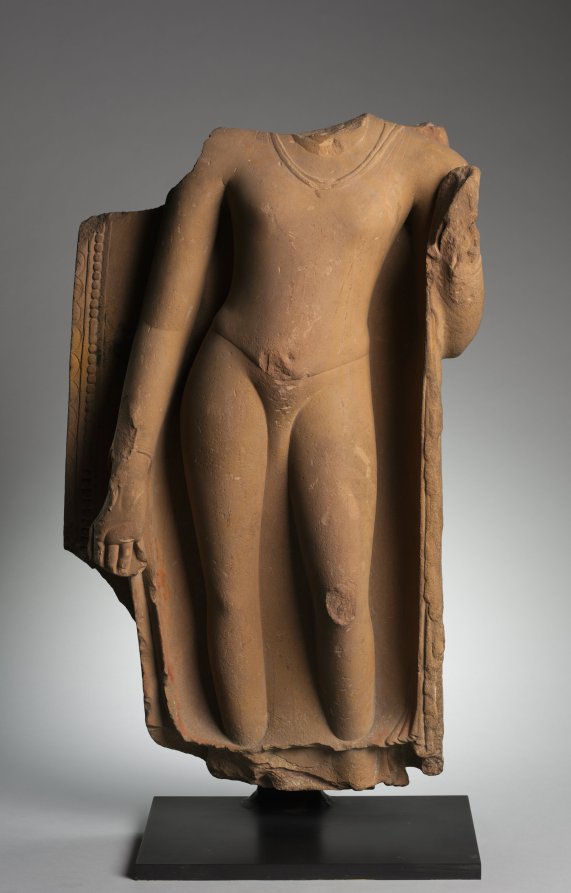
Standing Buddha (400s CE) is in the Cleveland Museum of Art collection.
The work and its context
The museum's open-access catalogue describes the work:
Depicting the Buddha in a plain robe that clings to the body, without interrupting the beauty of its contours, was a new development in the sculptural workshops of Sarnath during the 400s CE. Sarnath is located near the ancient city of Varanasi on the banks of the Ganges River and is identified as the place where the Buddha gave his first teaching. This form spread by means of portable images to peninsular Southeast Asia.
Object facts
- Title: Standing Buddha
- Date: 400s CE
- Culture: Northern India, Uttar Pradesh, Sarnath
- Type: Sculpture
- Technique: sandstone
- Dimensions: Overall: 76.2 cm (30 in.)
- Collection: Indian Art
- Department: Indian and Southeast Asian Art
- Accession number: 1943.278
Collection credit
Purchase from the J. H. Wade Fund
Further reading listed by the museum
- Lee, Sherman E. Buddhist Art. Detroit Institute of Arts, Twenty-Fourth Loan Exhibition, October, 1942. Detroit: Detroit Institute of Arts, 1942.
- Hollis, Howard. “Three Indian Buddhist Sculptures.” The Bulletin of the Cleveland Museum of Art, vol. 31, no. 3, 1944, pp. 33–37.
- Trubner, Henry. The Art of Greater India, 3000 B.C.-1800 A.D.; An Exhibition of Indian Art Presented Under the Patronage of the Embassy of India Functioning for the Government of India. March 1 to Apr. 16, 1950. Los Angeles, CA: Los Angeles County Museum, 1950.
View the collection record
See the museum's photographs and full catalogue entry. Catalogue text is reproduced from the Cleveland Museum of Art's open-access data, with HTML formatting removed. This object and its supplied image are designated CC0.
Sources
More in Lifestyle
Keep reading