Standing Disciple Mahakasyapa Holding a Cylindrical Reliquary (c. 550): Art, History and Details
Standing Disciple Mahakasyapa Holding a Cylindrical Reliquary at the Cleveland Museum of Art: c. 550, limestone with traces of pigment. Explore the work's context, creator attribution and collection history.
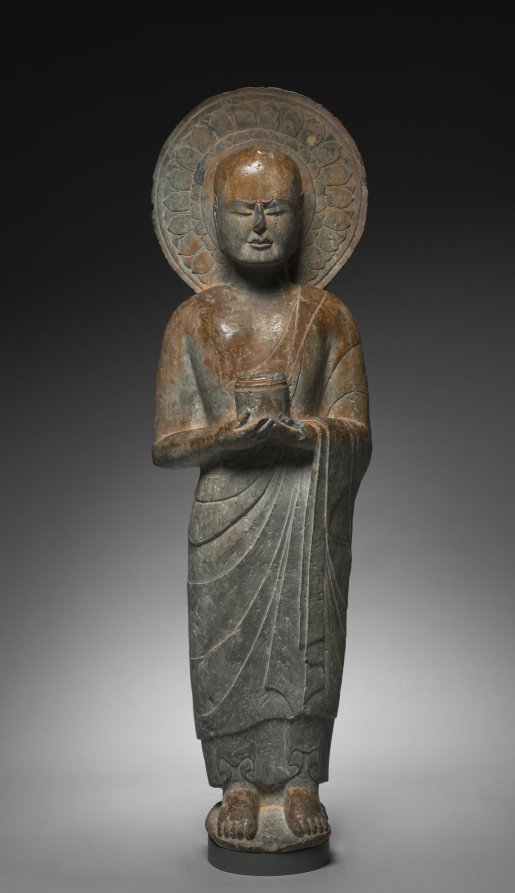
Standing Disciple Mahakasyapa Holding a Cylindrical Reliquary (c. 550) is in the Cleveland Museum of Art collection.
The work and its context
The museum's open-access catalogue describes the work:
Mahakasyapa, the disciple of Shakyamuni, is presented with closed eyes in an expression of meditative concentration. He is holding a reliquary for the Buddha’s ashes, which symbolize the Buddha entering final spiritual attainment (nirvana) at death. The artistic simplicity exemplifies the spiritual content of this figure.
Object facts
- Title: Standing Disciple Mahakasyapa Holding a Cylindrical Reliquary
- Date: c. 550
- Culture: China, Hebei province, Southern Xiangtangshan caves, Northern Qi dynasty (550-577)
- Type: Sculpture
- Technique: limestone with traces of pigment
- Dimensions: Overall: 116 x 33 x 25 cm (45 11/16 x 13 x 9 13/16 in.)
- Collection: China - Southern Dynasties
- Department: Chinese Art
- Accession number: 1972.166
A detail from the museum
The complex of Buddhist cave temples at Xiangtangshan, “Mountain of Echoing Halls,” is a central achievement of the Northern Qi period.
Collection credit
Leonard C. Hanna Jr. Fund
Further reading listed by the museum
- Musée Cernuschi. Collection Victor Goloubew. [Paris]: [Victor Jacquemin], 1913.
- Sirén, Osvald. Chinese Sculpture from the Fifth to the Fourteenth Century; over 900 Specimens in Stone, Bronze, Lacquer and Wood, Principally from Northern China. London: E. Benn, Limited, 1925.
- Mizuno, Seiichi 水野清一 and Toshio Nagahiro 長廣敏雄. Kyōdōzan sekkutsu: Kahoku Kanan shōkyō ni okeru Hokusei jidai no sekkutsu jiin. [響堂山石窟 : 河北河南省境における北齊時代の石窟寺院 = The Buddhist Cave-Temples of Hsiang-t'ang-ssu] Kyōto: Tōhō Bunka Gakuin Kyōto Kenkyūjo, 1937.
View the collection record
See the museum's photographs and full catalogue entry. Catalogue text is reproduced from the Cleveland Museum of Art's open-access data, with HTML formatting removed. This object and its supplied image are designated CC0.
Sources
More in Lifestyle
Keep reading