Stater: Head of Bearded Herakles (obverse); Horse (reverse) (389–369 BCE): Art, History and Details
Stater: Head of Bearded Herakles (obverse); Horse (reverse) at the Cleveland Museum of Art: 389–369 BCE, silver. Explore the work's context, creator attribution and collection history.
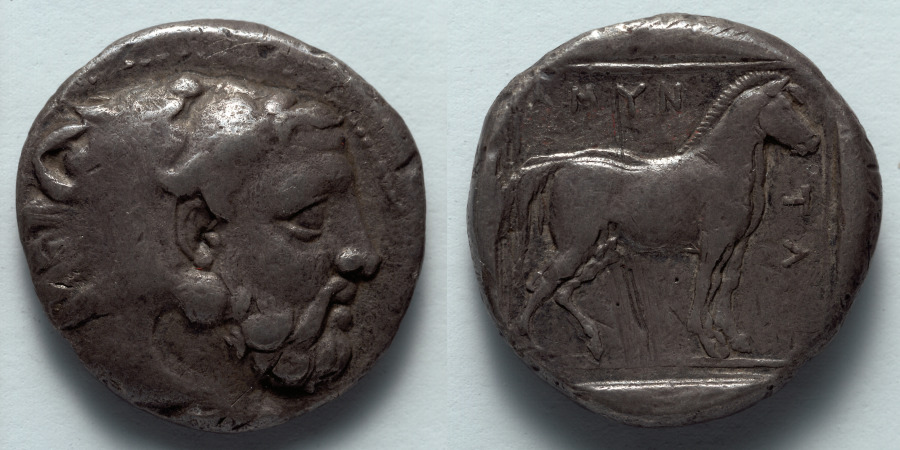
Stater: Head of Bearded Herakles (obverse); Horse (reverse) (389–369 BCE) is in the Cleveland Museum of Art collection.
The work and its context
The museum's open-access catalogue describes the work:
An older, bearded Herakles wears his lion-skin on the obverse of this coin, surrounded by a beaded border. On the reverse, a horse stands within an incuse square, where the inscription ΑΜΥΝ ΤΑ identifies King Amyntas III as ruler. The pairing of head and horse extends back to the earlier Macedonian king Archelaus (413-399 BC), though a young male head sometimes takes the place of Herakles.
Object facts
- Title: Stater: Head of Bearded Herakles (obverse); Horse (reverse)
- Date: 389–369 BCE
- Culture: Greek, Macedonian, probably minted at Pella (Macedonia), reign of Amyntas III
- Type: Coins
- Technique: silver
- Dimensions: Diameter: 2.1 cm (13/16 in.)
- Collection: GR - Greek
- Department: Greek and Roman Art
- Accession number: 1916.990
A detail from the museum
Amyntas III was the father of Philip II and grandfather of Alexander III (the Great).
Collection credit
Gift of J. H. Wade
View the collection record
See the museum's photographs and full catalogue entry. Catalogue text is reproduced from the Cleveland Museum of Art's open-access data, with HTML formatting removed. This object and its supplied image are designated CC0.
Sources
More in Lifestyle
Keep reading