Stater: Lion (obverse); Incuse Punches (reverse) (600–550 BCE): Art, History and Details
Stater: Lion (obverse); Incuse Punches (reverse) at the Cleveland Museum of Art: 600–550 BCE, Electrum (gold-silver alloy). Explore the work's context, creator attribution and collection history.
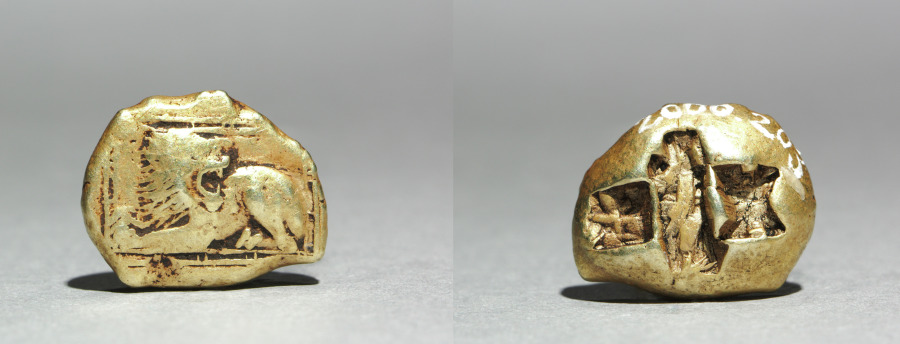
Stater: Lion (obverse); Incuse Punches (reverse) (600–550 BCE) is in the Cleveland Museum of Art collection.
The work and its context
The museum's open-access catalogue describes the work:
The lion, king of the beasts and an animal associated with regal and heroic power, featured prominently on the coinage of many ancient Greek city-states. Artists placed the lion in a variety of poses, sometimes including the whole body, at other times the foreparts or just the head. Although it may once have roamed nearby, for many Greeks the lion was a monster nearly as exotic as the Chimaera, of which it formed a part, together with a goat head and snake-headed tail.
Object facts
- Title: Stater: Lion (obverse); Incuse Punches (reverse)
- Date: 600–550 BCE
- Culture: Greek, minted at Miletos (Ionia)
- Type: Coins
- Technique: Electrum (gold-silver alloy)
- Dimensions: Overall: 1.6 x 2 x 0.8 cm (5/8 x 13/16 x 5/16 in.)
- Collection: GR - Greek
- Department: Greek and Roman Art
- Accession number: 2000.203
A detail from the museum
Many early Greek coins are made from electrum, a naturally occurring alloy of gold and silver.
Collection credit
Gift of Bruce Ferrini
View the collection record
See the museum's photographs and full catalogue entry. Catalogue text is reproduced from the Cleveland Museum of Art's open-access data, with HTML formatting removed. This object and its supplied image are designated CC0.
Sources
More in Lifestyle
Keep reading