Stater: Plain (obverse); Horse (reverse) (c. 57–45 BCE): Art, History and Details
Stater: Plain (obverse); Horse (reverse) at the Cleveland Museum of Art: c. 57–45 BCE, gold. Explore the work's context, creator attribution and collection history.
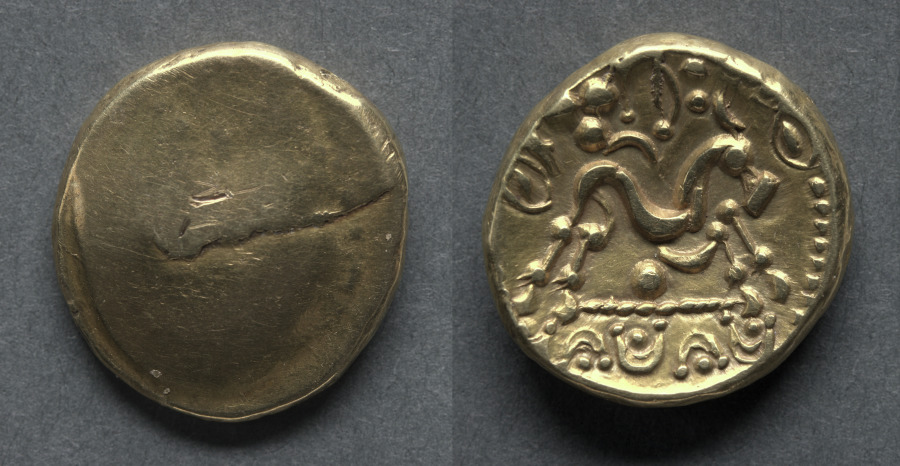
Stater: Plain (obverse); Horse (reverse) (c. 57–45 BCE) is in the Cleveland Museum of Art collection.
The work and its context
The museum's open-access catalogue describes the work:
Julius Caesar recorded that in the year 57 BC, chieftains who had unsuccessfully resisted him in Gaul took refuge in Britain. This wave of refugees brought with them, and probably also struck in Britain, the staters known as the Gallo-Belgic type (this specific one is known as the Morini type). There is no sign of any part of an obverse design and the horse, now detached from the chariot, has become extremely crude in design. The minting technique however, is good as the design is clear-cut and sharp.
Object facts
- Title: Stater: Plain (obverse); Horse (reverse)
- Date: c. 57–45 BCE
- Culture: England
- Type: Coins
- Technique: gold
- Dimensions: Diameter: 1.7 cm (11/16 in.)
- Collection: MED - Numismatics
- Department: Medieval Art
- Accession number: 1969.145
A detail from the museum
When struck this coin became concave, curving inward.
Collection credit
The Norweb Collection
Further reading listed by the museum
- Cleveland Museum of Art, and Emery May Norweb. English Gold Coins, Ancient to Modern Times, On Loan to the Cleveland Museum of Art from the Norweb Collection. 1968.
- Emery May Norweb Collection (Cleveland, Ohio), Emery May Norweb, C. E. Blunt, F. Elmore Jones, and R. P. Mack. Collection of Ancient British, Romano-British and English Coins. London: Spink, 1971.
View the collection record
See the museum's photographs and full catalogue entry. Catalogue text is reproduced from the Cleveland Museum of Art's open-access data, with HTML formatting removed. This object and its supplied image are designated CC0.
Sources
More in Lifestyle
Keep reading