Stater: Wreath, Cloak, and Crescents (obverse); Horse and Wing Motif (reverse) (c. 60–20 BCE): Art, History and Details
Stater: Wreath, Cloak, and Crescents (obverse); Horse and Wing Motif (reverse) at the Cleveland Museum of Art: c. 60–20 BCE, gold. Explore the work's context, creator attribution and collection history.
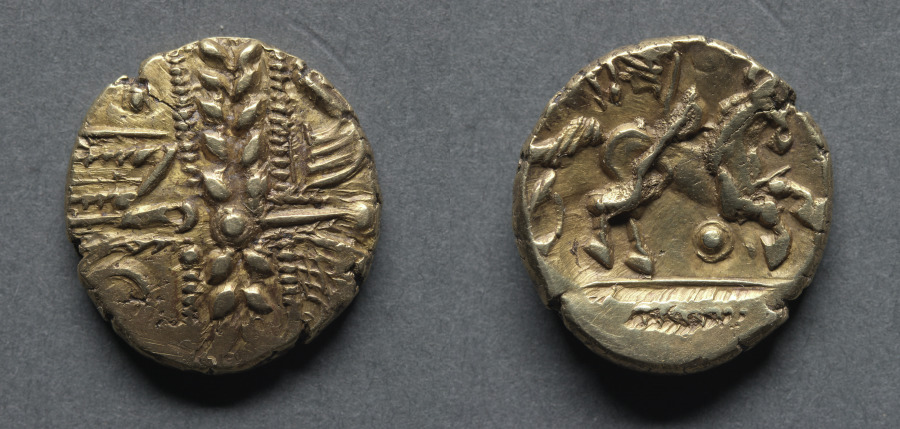
Stater: Wreath, Cloak, and Crescents (obverse); Horse and Wing Motif (reverse) (c. 60–20 BCE) is in the Cleveland Museum of Art collection.
The work and its context
The museum's open-access catalogue describes the work:
This particular type of stater received its type name, Whaddon Chase, from a hoard of over 320 such pieces which were turned up by a plow in a field called Narbury on the Whaddon Hall estate, Buckinghamshire, on February 14, 1849. The surrounding countryside is known as Whaddon Chase, the name still in use today. This area is well within the territory of the Catuvellaunia.
Object facts
- Title: Stater: Wreath, Cloak, and Crescents (obverse); Horse and Wing Motif (reverse)
- Date: c. 60–20 BCE
- Culture: England, Catuvellauni
- Type: Coins
- Technique: gold
- Dimensions: Diameter: 1.9 cm (3/4 in.)
- Collection: MED - Numismatics
- Department: Medieval Art
- Accession number: 1969.149
A detail from the museum
The fortunes of the Catuvellauni and their kings can be traced through ancient coins.
Collection credit
The Norweb Collection
Further reading listed by the museum
- Cleveland Museum of Art, and Emery May Norweb. English Gold Coins, Ancient to Modern Times, On Loan to the Cleveland Museum of Art from the Norweb Collection. 1968.
- Emery May Norweb Collection (Cleveland, Ohio), Emery May Norweb, C. E. Blunt, F. Elmore Jones, and R. P. Mack. Collection of Ancient British, Romano-British and English Coins. London: Spink, 1971.
View the collection record
See the museum's photographs and full catalogue entry. Catalogue text is reproduced from the Cleveland Museum of Art's open-access data, with HTML formatting removed. This object and its supplied image are designated CC0.
Sources
More in Lifestyle
Keep reading