Statue of Amitabha (800s): Art, History and Details
Statue of Amitabha at the Cleveland Museum of Art: 800s, gilt bronze. Explore the work's context, creator attribution and collection history.
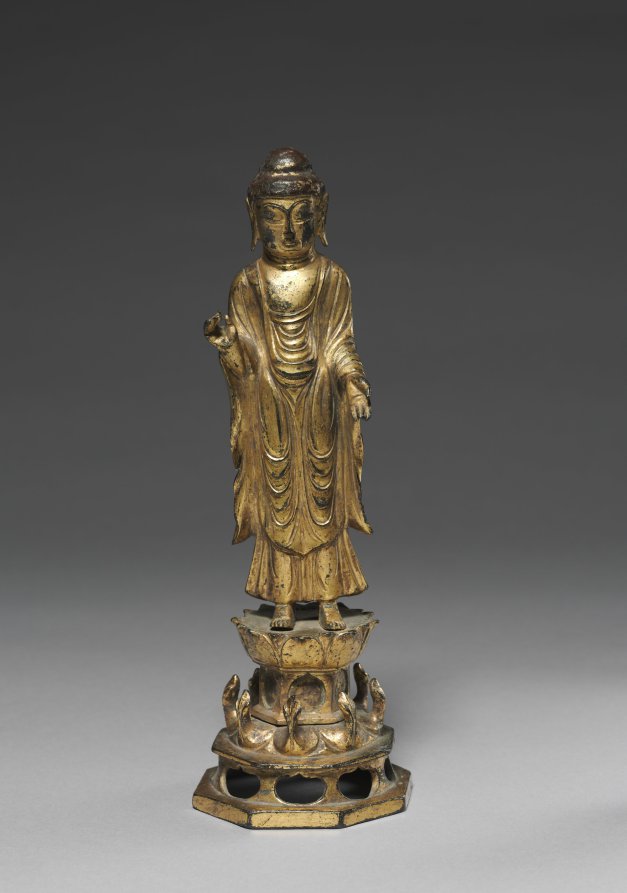
Statue of Amitabha (800s) is in the Cleveland Museum of Art collection.
The work and its context
The museum's open-access catalogue describes the work:
This small sculpture shows Amitabha, the Buddha of the Western Paradise and the focus of the Pure Land sect of Buddhism, which was popular across East Asia, including Korea. This deity is recognizable from its right hand raised palm out in a gesture that reassures viewers to have no fear.
Object facts
- Title: Statue of Amitabha
- Date: 800s
- Culture: Korea, Unified Silla period (676-935)
- Type: Sculpture
- Technique: gilt bronze
- Dimensions: Overall: 22.5 x 7.2 x 7.2 cm (8 7/8 x 2 13/16 x 2 13/16 in.)
- Collection: Korean Art
- Department: Korean Art
- Accession number: 1998.79
A detail from the museum
Small statues like this work were designed to be portable, rather than to be permanently housed in a Buddhist temple.
Collection credit
John L. Severance Fund
Further reading listed by the museum
- Gwak, Dong-seok. Hanguk ui geumdongbul [한국의 금동불] . Seoul: Dareun sesang, 2016.
- Nelson, Sarah. Gyeongju: The Capital of Golden Silla. Routledge, 2019.
- Kang, U-bang. Hangung bulgyo jogang ui heureum [한국 불교 조각 의 흐름]. Soeul: Daewonsa, 1995.
View the collection record
See the museum's photographs and full catalogue entry. Catalogue text is reproduced from the Cleveland Museum of Art's open-access data, with HTML formatting removed. This object and its supplied image are designated CC0.
Sources
More in Lifestyle
Keep reading