Statuette of a Kouros (600–480 BCE): Art, History and Details
Statuette of a Kouros at the Cleveland Museum of Art: 600–480 BCE, bronze. Explore the work's context, creator attribution and collection history.
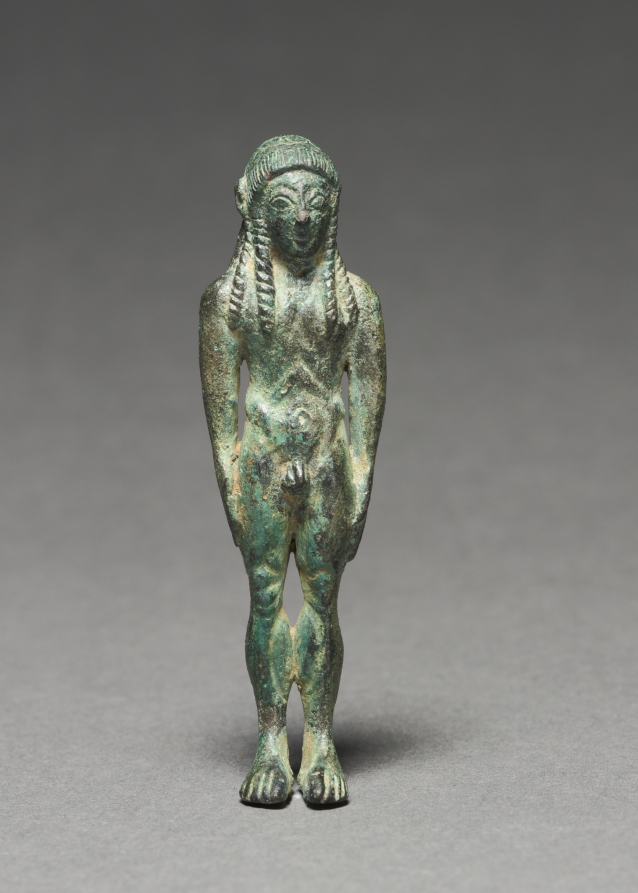
Statuette of a Kouros (600–480 BCE) is in the Cleveland Museum of Art collection.
The work and its context
The museum's open-access catalogue describes the work:
Though almost certainly Etruscan in origin, this small-scale bronze takes the form of a Greek kouros, a nude male youth with arms at sides looking straight ahead. The left foot appears ever so slightly advanced, but not enough to create any real sense of movement. Two long locks of hair fall over each shoulder, recalling Ionian (East Greek) examples, but the scale-like pattern on the back of the head is unusual. Despite the lack of nudity in most other Archaic Etruscan artworks, the kouros became quite popular as a small bronze votive type in Etruria.
Object facts
- Title: Statuette of a Kouros
- Date: 600–480 BCE
- Culture: Etruscan
- Type: Sculpture
- Technique: bronze
- Dimensions: Overall: 8.8 cm (3 7/16 in.)
- Collection: GR - Etruscan
- Department: Greek and Roman Art
- Accession number: 1971.264
A detail from the museum
Unlike Greek kouroi, which range in medium and scale, Etruscan kouroi are primarily small bronzes.
Collection credit
Sundry Purchase Fund
Further reading listed by the museum
- “Annual Report for 1971.” The Bulletin of the Cleveland Museum of Art 59, no. 6 (1972): 147–79.
View the collection record
See the museum's photographs and full catalogue entry. Catalogue text is reproduced from the Cleveland Museum of Art's open-access data, with HTML formatting removed. This object and its supplied image are designated CC0.
Sources
More in Lifestyle
Keep reading
Related stories