Statuette of Harpocrates (c. 50 BCE): Art, History and Details
Statuette of Harpocrates at the Cleveland Museum of Art: c. 50 BCE, bronze, hollow cast, with silver inlays. Explore the work's context, creator attribution and collection history.
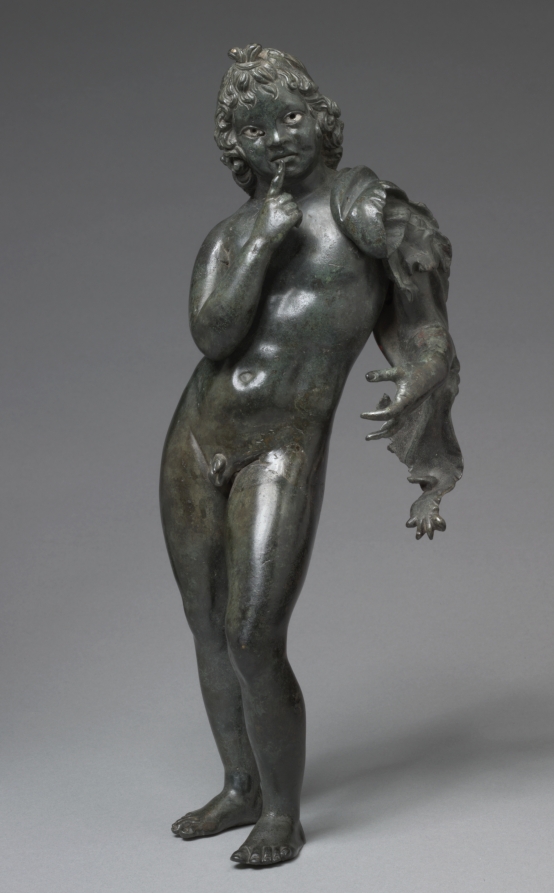
Statuette of Harpocrates (c. 50 BCE) is in the Cleveland Museum of Art collection.
The work and its context
The museum's open-access catalogue describes the work:
Combining Hellenistic naturalism with a finger gesture associated with childhood in Egyptian tradition, this young figure represents Harpocrates, the Greek form of the Egyptian child sun god Horus, or Hor-pa-khred. A hole atop his head likely once held a double crown of Egypt, as on more traditionally Egyptian representations of Harpocrates.
Object facts
- Title: Statuette of Harpocrates
- Date: c. 50 BCE
- Culture: Greece, Greco-Roman Period, late Ptolemaic Dynasty
- Type: Sculpture
- Technique: bronze, hollow cast, with silver inlays
- Dimensions: Overall: 27 x 10.2 x 8.6 cm (10 5/8 x 4 x 3 3/8 in.)
- Collection: GR - Greek
- Department: Greek and Roman Art
- Accession number: 1972.6
A detail from the museum
The gesture this figure makes refers to the Egyptian hieroglyph for child, nn, 𓀁.
Collection credit
Purchase from the J. H. Wade Fund
Further reading listed by the museum
- Cleveland Museum of Art, and Arielle P. Kozloff. An Introduction to the Art of Egypt in the Cleveland Museum of Art. [Cleveland]: [The Museum], 1970.
- Cooney, John D. "Harpocrates, the Dutiful Son." The Bulletin of the Cleveland Museum of Art 59, no. 10 (1972)
- Lee, Sherman E. "The Year in Review for 1972." The Bulletin of the Cleveland Museum of Art 60, no. 3 (1973)
View the collection record
See the museum's photographs and full catalogue entry. Catalogue text is reproduced from the Cleveland Museum of Art's open-access data, with HTML formatting removed. This object and its supplied image are designated CC0.
Sources
More in Lifestyle
Keep reading
Related stories