Storage Jar (1350–99): Art, History and Details
Storage Jar at the Cleveland Museum of Art: 1350–99, Stoneware with natural ash glaze and impressed designs (Tokoname ware). Explore the work's context, creator attribution and collection history.
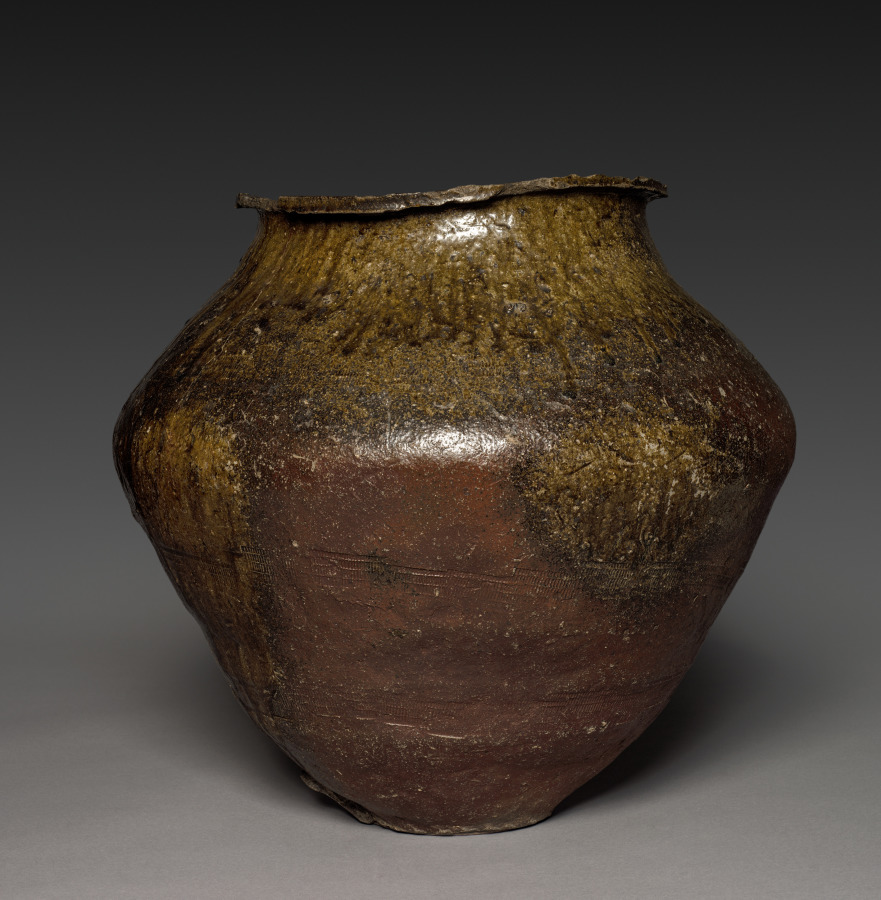
Storage Jar (1350–99) is in the Cleveland Museum of Art collection.
The work and its context
The museum's open-access catalogue describes the work:
This storage jar was made by piling coils of clay atop one another, smoothing the inner and outer surfaces, and allowing the clay to dry before adding another section of the form. The wide rim and mouth were then added using a potter’s wheel. Because of its small base, the vessel could stand safely on a narrow step on the steep slope of a rising kiln floor. Such kilns were built into the side of a hill and used wood for firing. The natural ash glazes took about a week to 10 days to form.
Object facts
- Title: Storage Jar
- Date: 1350–99
- Culture: Japan, Nanbokuchō period (1336–92)
- Type: Ceramic
- Technique: Stoneware with natural ash glaze and impressed designs (Tokoname ware)
- Dimensions: Diameter: 55.3 cm (21 3/4 in.); Overall: 51 cm (20 1/16 in.)
- Collection: Japanese Art
- Department: Japanese Art
- Accession number: 1992.356
Collection credit
Gift of George Gund
Further reading listed by the museum
- Turner, Evan H. “The Year in Review for 1992.” The Bulletin of the Cleveland Museum of Art 80, no. 2 (February 1993): 38–79.
- Grossman, Nancy, James T. Ulak, Marjorie Williams, and Laurence Channing. Art of Japan: Masterpieces from the Cleveland Museum of Art. Cleveland, OH: The Cleveland Museum of Art, 2005.
View the collection record
See the museum's photographs and full catalogue entry. Catalogue text is reproduced from the Cleveland Museum of Art's open-access data, with HTML formatting removed. This object and its supplied image are designated CC0.
Sources
More in Lifestyle
Keep reading