Storage Jar (1400s): Art, History and Details
Storage Jar at the Cleveland Museum of Art: 1400s, Stoneware with natural ash glaze (Tamba ware). Explore the work's context, creator attribution and collection history.
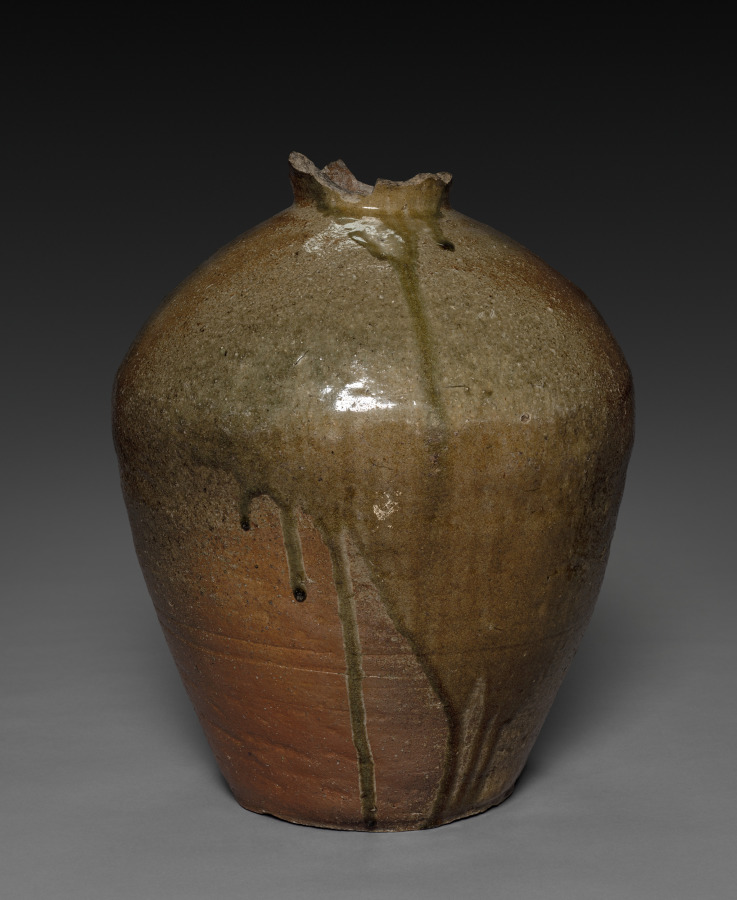
Storage Jar (1400s) is in the Cleveland Museum of Art collection.
The work and its context
The museum's open-access catalogue describes the work:
For centuries the Tokai region surrounding present-day Nagoya has been an especially fertile ceramic production center. One site was a group of kilns located west of Kyoto, in Tamba province. Nestled in a farming valley in the mountains behind the modern port of Kobe, Tamba required a regular supply of storage vessels and sturdy containers for distributing grain. This jar was formed in three sections, each fluted to the next and turned on a potter's wheel to scrape off excess material. Both interior and exterior walls were smoothed with a wooden or bamboo tool, leaving markings on the lower body and shoulder. The neck opening is small and wheel-turned, as is the neck, which bears fine lines and a matte-glazed surface. The lustrous green glaze that highlights the jar once trailed from the vessel's lip and clung to the entire shoulder wall, mingling with the warm, orange-brown tone of the clay body underneath. The surface is crackled with craters where stone material within the clay migrated up to the surface during firing and then fell away. The result is a particularly rich and varied "landscape," typical of Tamba ware's subdued, earthy vitality.
Object facts
- Title: Storage Jar
- Date: 1400s
- Culture: Japan, Muromachi period (1392–1573)
- Type: Ceramic
- Technique: Stoneware with natural ash glaze (Tamba ware)
- Dimensions: Diameter: 37 cm (14 9/16 in.); Overall: 46.5 cm (18 5/16 in.)
- Collection: Japanese Art
- Department: Japanese Art
- Accession number: 2015.494
Collection credit
Gift from the Collection of George Gund III
Further reading listed by the museum
- Longhi, Leighton R. Leighton R. Longhi: Forty-Five Years in Asian Art. [New York, N.Y.]: Leighton R. Longhi, 2019.
View the collection record
See the museum's photographs and full catalogue entry. Catalogue text is reproduced from the Cleveland Museum of Art's open-access data, with HTML formatting removed. This object and its supplied image are designated CC0.
Sources
More in Lifestyle
Keep reading