String of Glass Beads (400s CE): Art, History and Details
String of Glass Beads at the Cleveland Museum of Art: 400s CE, glass. Explore the work's context, creator attribution and collection history.
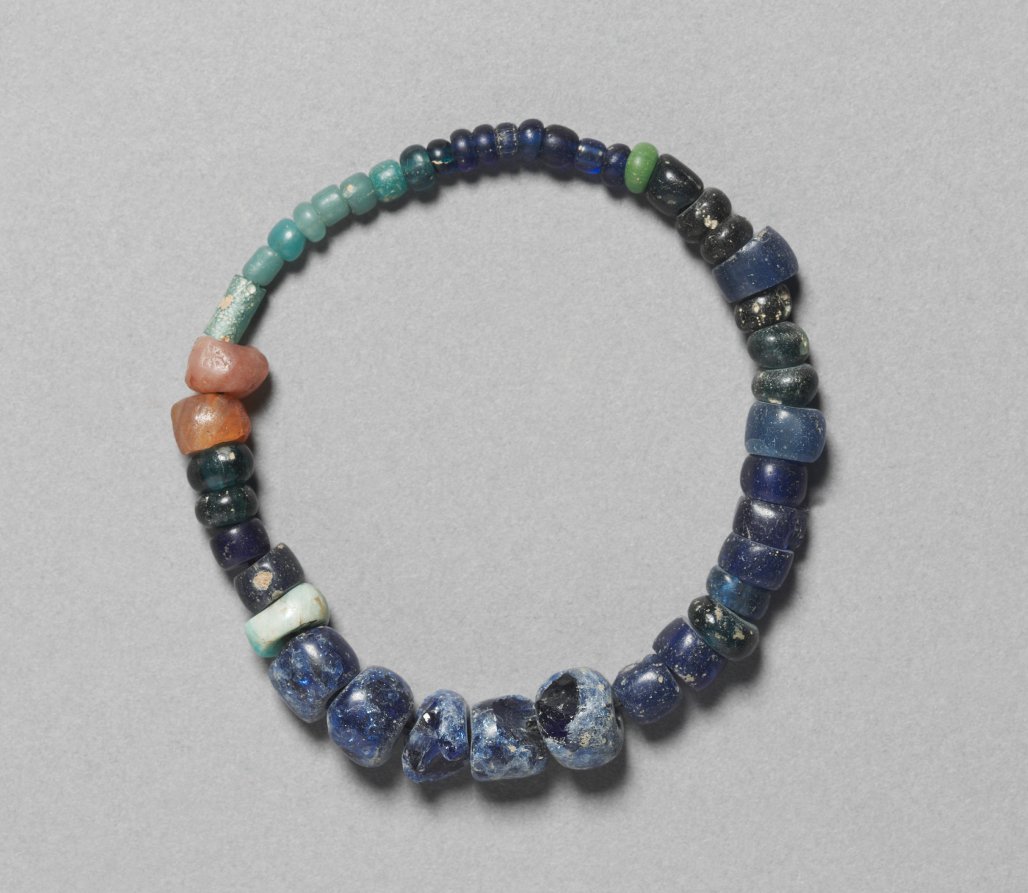
String of Glass Beads (400s CE) is in the Cleveland Museum of Art collection.
The work and its context
The museum's open-access catalogue describes the work:
An enormous amount of beaded strings and necklaces were excavated from Silla tomb sites. Glass, largely produced in ancient Rome since the late 1st century, also reached the Korean peninsula through the Silk Road, the ancient global trade route. Yet cobalt blue glass beads shown in this string are highly likely to be soda glass produced in the Silla territory.
Object facts
- Title: String of Glass Beads
- Date: 400s CE
- Culture: Korea, Three Kingdoms period (57 BCE–668 CE)
- Type: Jewelry
- Technique: glass
- Collection: Korean Art
- Department: Korean Art
- Accession number: 1917.1058
A detail from the museum
Glass, largely produced in ancient Rome since the late 1st century, also reached the Korean peninsula through the Silk Road, the ancient global trade route. Yet, cobalt blue glass beads shown in this work are highly likely to have been produced in the Silla territory.
Collection credit
Gift of the John Huntington Art and Polytechnic Trust
Further reading listed by the museum
- Golden Splendors: the Royal Tomb of Silla Hwangnamdaechong [황남대총: 황금의나라신라의왕릉]. Seoul: National Museum of Korea, 2010.
- Lee, So-young, and Denise Patry Leidy. Silla: Korea's Golden Kingdom. New York: The Metropolitan Museum of Art, 2013.
- Park, Jun-young. “Characteristic and Development Ancient Glass Beads in Korea [韓國 古代 琉璃구슬의 特徵과 展開樣相].” Jungang gogo yeogu 19 (2016): 71-109.
View the collection record
See the museum's photographs and full catalogue entry. Catalogue text is reproduced from the Cleveland Museum of Art's open-access data, with HTML formatting removed. This object and its supplied image are designated CC0.
Sources
More in Lifestyle
Keep reading