Studies of Insects (c. 1665–1727): Art, History and Details
Studies of Insects at the Cleveland Museum of Art: c. 1665–1727, watercolor, opaque watercolor, and gum arabic with brown ink framing lines. Explore the work's context, creator attribution and collection history.
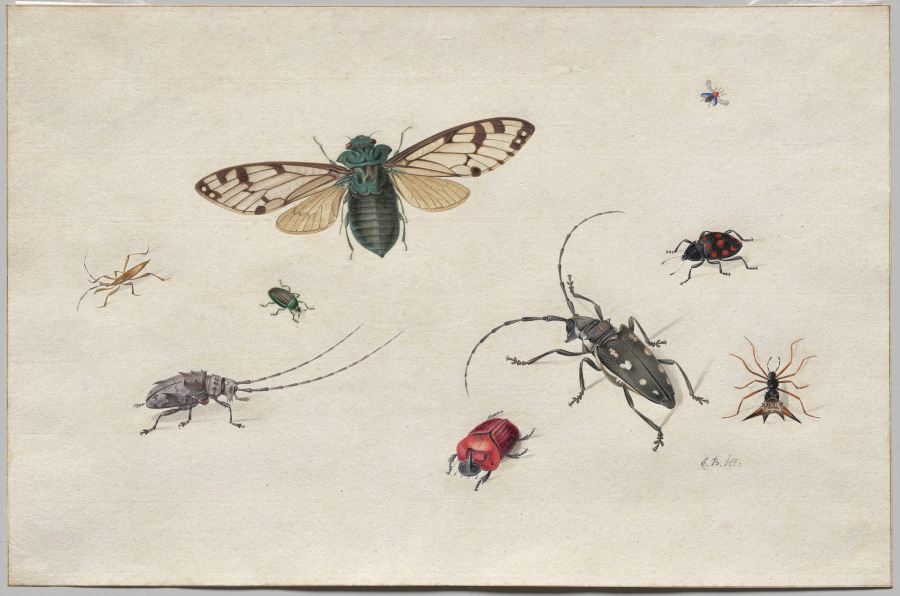
Studies of Insects (c. 1665–1727) is in the Cleveland Museum of Art collection. The museum's creator attribution is Johannes Bronckhorst (Netherlands, 1648–1727).
The work and its context
The museum's open-access catalogue describes the work:
In the 17th century, an interest in flora and fauna, both local and exotic, in the Netherlands led to vast collections of insects, plants, and animals among academics and amateurs. Artists such as Johannes Bronckhorst became specialists at recording these collections in paint, to be kept in portfolios and shown to visitors. The grouping of insects on this sheet suggest that Bronckhorst had access to a varied collection, and include a cicada, a cereal-leaf beetle, a harlequin ladybird, a spiny orb-weaver spider, two Asian longhorn beetles, a red rhinoceros beetle, a rosemary beetle, and a stick insect. With great attention to detail, Bronckhorst may have selected this particular assembly with no other intent than to create a balanced and colorful composition.
Object facts
- Title: Studies of Insects
- Date: c. 1665–1727
- Creator attribution: Johannes Bronckhorst (Netherlands, 1648–1727)
- Culture: Netherlands
- Type: Drawing
- Technique: watercolor, opaque watercolor, and gum arabic with brown ink framing lines
- Dimensions: Sheet: 20.7 x 31.4 cm (8 1/8 x 12 3/8 in.)
- Collection: DR - Dutch
- Department: Drawings
- Accession number: 2022.9
A detail from the museum
With an extremely fine brush, the artist used a magnifying glass to draw the minute details of these insects, using watercolor and opaque watercolor, and gum arabic to create sheen.
Collection credit
Dudley P. Allen Fund
Further reading listed by the museum
- Christie's Amsterdam B.V. The I.Q. Van Regteren Altena Collection, Part II: Dutch and Flemish Drawings from 1500-1900. Amsterdam: Christie's, 2014.
View the collection record
See the museum's photographs and full catalogue entry. Catalogue text is reproduced from the Cleveland Museum of Art's open-access data, with HTML formatting removed. This object and its supplied image are designated CC0.
Sources
More in Lifestyle
Keep reading
Related stories