Summer Flowers (mid-1600s): Art, History and Details
Summer Flowers at the Cleveland Museum of Art: mid-1600s, hanging scroll; ink, color, and gold on paper. Explore the work's context, creator attribution and collection history.
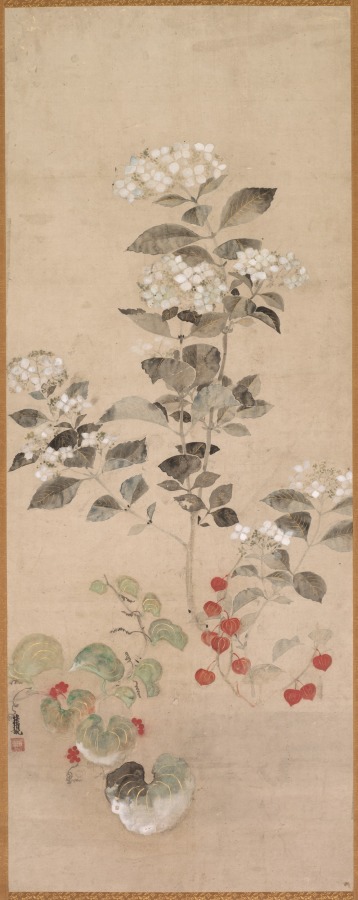
Summer Flowers (mid-1600s) is in the Cleveland Museum of Art collection. The museum's creator attribution is Kitagawa Sōsetsu (Japanese, active 1639–50).
The work and its context
The museum's open-access catalogue describes the work:
White hydrangea, orange-colored demon’s lantern, and greenbrier vine appear together in this scroll. The artist used the dripping-in (tarashikomi) technique to create a sense of depth and dimension in the leaves of the plants. A carefully controlled brush loaded with a high ratio of water to ink or color is key to the success of this brush method. Gold lines indicate the veins of leaves and the seams of pods.
Object facts
- Title: Summer Flowers
- Date: mid-1600s
- Creator attribution: Kitagawa Sōsetsu (Japanese, active 1639–50)
- Culture: Japan, Edo period (1615–1868)
- Type: Painting
- Technique: hanging scroll; ink, color, and gold on paper
- Dimensions: Overall: 197.6 x 65.5 cm (77 13/16 x 25 13/16 in.); Painting only: 107.5 x 45.8 cm (42 5/16 x 18 1/16 in.)
- Collection: ASIAN - Hanging scroll
- Department: Japanese Art
- Accession number: 1992.380
Collection credit
Bequest of Maud Eells Corning
View the collection record
See the museum's photographs and full catalogue entry. Catalogue text is reproduced from the Cleveland Museum of Art's open-access data, with HTML formatting removed. This object and its supplied image are designated CC0.
Sources
More in Lifestyle
Keep reading