Surya, the Sun God (early 700s): Art, History and Details
Surya, the Sun God at the Cleveland Museum of Art: early 700s, brass with inlaid silver eyes and copper inlaid lips. Explore the work's context, creator attribution and collection history.
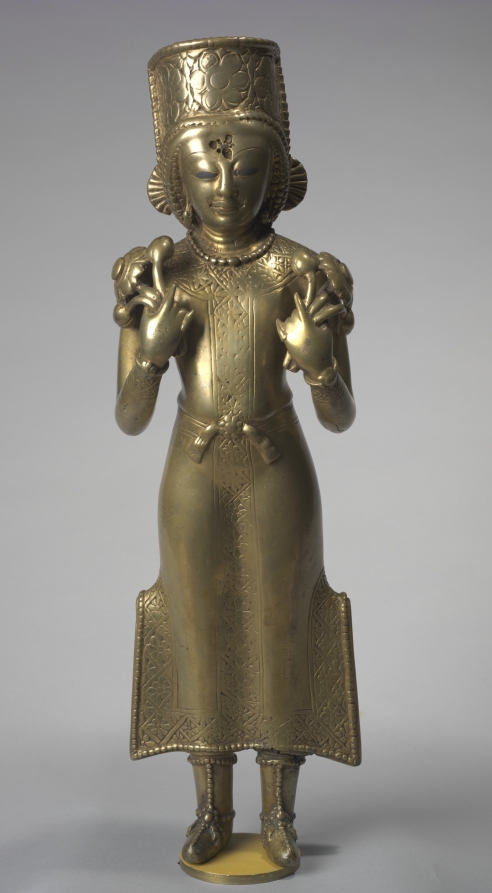
Surya, the Sun God (early 700s) is in the Cleveland Museum of Art collection.
The work and its context
The museum's open-access catalogue describes the work:
Surya wears a long tunic and boots suitable for riding horses across the grassland steppes of Central Asia. The sun god was of paramount power among the people of Central and Western Asia who followed religions such as Zoroastrianism, a pre-Islamic faith emphasizing a sacred duality between light and dark. When the image of the sun god began to be made in India from the 100s BC on, he is shown in the dress of the people who revered him the most. Surya is worshipped throughout the Indian subcontinent and Himalayan regions of Kashmir and Nepal alongside both Hindu and Buddhist deities.
Object facts
- Title: Surya, the Sun God
- Date: early 700s
- Culture: India, Kashmir
- Type: Sculpture
- Technique: brass with inlaid silver eyes and copper inlaid lips
- Dimensions: Overall: 50.4 cm (19 13/16 in.)
- Collection: Indian Art
- Department: Indian and Southeast Asian Art
- Accession number: 1965.557
Collection credit
Gift of Katharine Holden Thayer
Further reading listed by the museum
- The Cleveland Museum of Art. Handbook of the Cleveland Museum of Art/1966. Cleveland, OH: The Cleveland Museum of Art, 1966.
- “Art of Asia Recently Acquired by American Museums, 1965.” Archives of Asian Art, vol. 20, 1966, pp. 84–113.
- Lee, Sherman E. “Golden Anniversary Acquisitions: September 10 through October 16.” The Bulletin of the Cleveland Museum of Art, vol. 53, no. 7, 1966, pp. 181–284.
View the collection record
See the museum's photographs and full catalogue entry. Catalogue text is reproduced from the Cleveland Museum of Art's open-access data, with HTML formatting removed. This object and its supplied image are designated CC0.
Sources
More in Lifestyle
Keep reading