Talatat: Men Hoeing the Earth (c. 1353–1347 BCE): Art, History and Details
Talatat: Men Hoeing the Earth at the Cleveland Museum of Art: c. 1353–1347 BCE, painted sandstone. Explore the work's context, creator attribution and collection history.
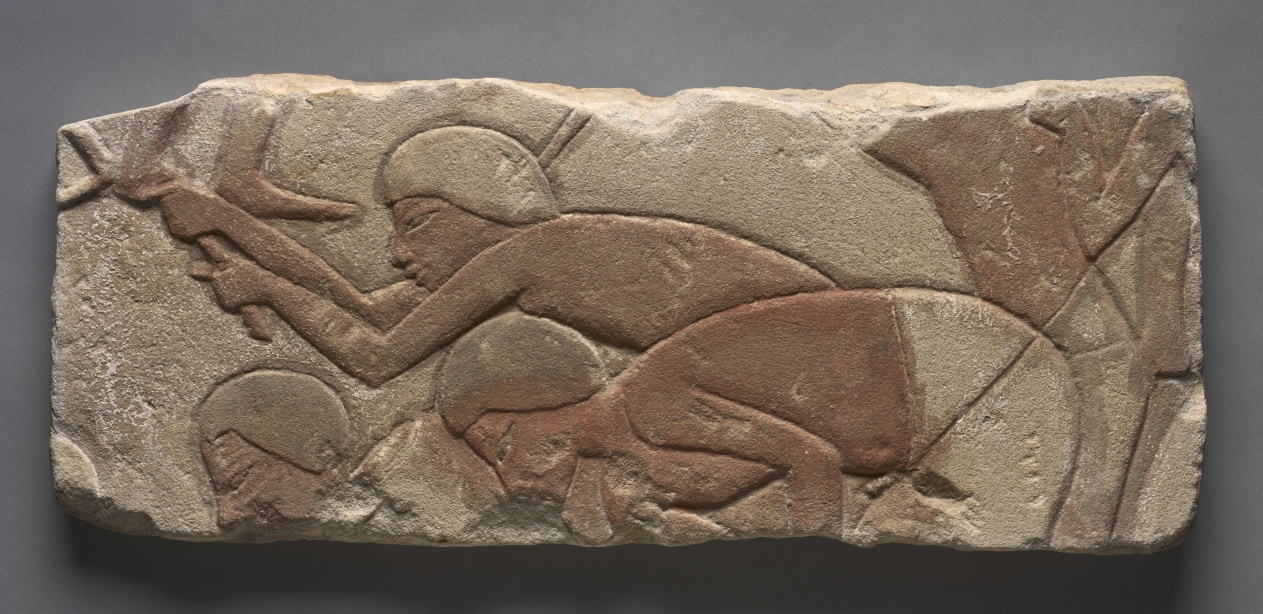
Talatat: Men Hoeing the Earth (c. 1353–1347 BCE) is in the Cleveland Museum of Art collection.
The work and its context
The museum's open-access catalogue describes the work:
In the early part of his reign, Amenhotep IV built an enormous temple to the sun disk (Aten) at the east end of the temple of Karnak. To expedite construction, sandstone was quarried in small, regularly sized, easily manageable blocks called talatat. Unlike the huge monoliths typically used in temple construction, talatat could be carried and moved into position by one man. Not all of the temple was built of stone, however. In this block, workmen are shown bent in toil. They once formed part of a panoramic scene depicting the production of mud bricks. The men are involved in the initial stages of this process: hacking up the earth and gathering the raw clay. It is very likely that this talatat represents a distinct historical event, undoubtedly connected with Amenhotep IV’s huge building enterprises at East Karnak.
Object facts
- Title: Talatat: Men Hoeing the Earth
- Date: c. 1353–1347 BCE
- Culture: Egypt, Karnak, New Kingdom (1540–1069 BCE), Dynasty 18, reign of Akhenaten (1351–1334 BCE)
- Type: Sculpture
- Technique: painted sandstone
- Dimensions: Overall: 21.4 x 53.3 cm (8 7/16 x 21 in.)
- Collection: Egypt - New Kingdom
- Department: Egyptian and Ancient Near Eastern Art
- Accession number: 1959.187
Collection credit
Purchase from the J. H. Wade Fund
Further reading listed by the museum
- Cleveland Museum of Art, and Martha L. Carter. Egyptian Art, the Cleveland Museum of Art. Cleveland, Ohio: The Museum, 1963.
- Cooney, John D. “Amarna Art in the Cleveland Museum.” The Bulletin of the Cleveland Museum of Art 55, no. 1 (January 1968): 2–17.
- Kozloff, Arielle P. “Nefertiti, Beloved of the Living Disk.” The Bulletin of the Cleveland Museum of Art 64, no. 9 (November 1977): 287–298.
View the collection record
See the museum's photographs and full catalogue entry. Catalogue text is reproduced from the Cleveland Museum of Art's open-access data, with HTML formatting removed. This object and its supplied image are designated CC0.
Sources
More in Lifestyle
Keep reading