Tapa Cloth Beater (l'e kuku) (before 1930): Art, History and Details
Tapa Cloth Beater (l'e kuku) at the Cleveland Museum of Art: before 1930, wood. Explore the work's context, creator attribution and collection history.
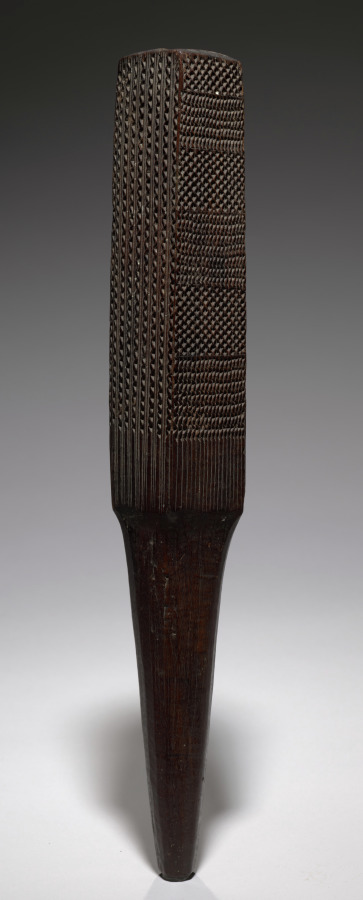
Tapa Cloth Beater (l'e kuku) (before 1930) is in the Cleveland Museum of Art collection.
The work and its context
The museum's open-access catalogue describes the work:
To make tapa, a decorated bark cloth, Hawaiian women used the four-sided beater to pound the inner bark of the paper mulberry tree, softened by a week of soaking in sea water. The cloth was beaten in several stages, starting with the most coarsely grooved side of the mallet and gradually reaching the finest grooved side. Although many Polynesian groups produced tapa cloth, only Hawaiian tapa cloth beaters were incised with a variety of "watermark" patterns. The prepared cloth was decorated with overlaying, cord snapping, free-hand painting, and printing techniques.
Object facts
- Title: Tapa Cloth Beater (l'e kuku)
- Date: before 1930
- Culture: Polynesia, Hawaii, 20th century
- Type: Sculpture
- Technique: wood
- Dimensions: Overall: 38.7 cm (15 1/4 in.)
- Collection: Oceanic Art
- Department: Oceania
- Accession number: 1971.152
Collection credit
Gift of Dr. and Mrs. Thomas Munro
View the collection record
See the museum's photographs and full catalogue entry. Catalogue text is reproduced from the Cleveland Museum of Art's open-access data, with HTML formatting removed. This object and its supplied image are designated CC0.
Sources
More in Lifestyle
Keep reading