Tapestry Fragment (700–1370s): Art, History and Details
Tapestry Fragment at the Cleveland Museum of Art: 700–1370s, camelid fiber and cotton, tapestry weave. Explore the work's context, creator attribution and collection history.
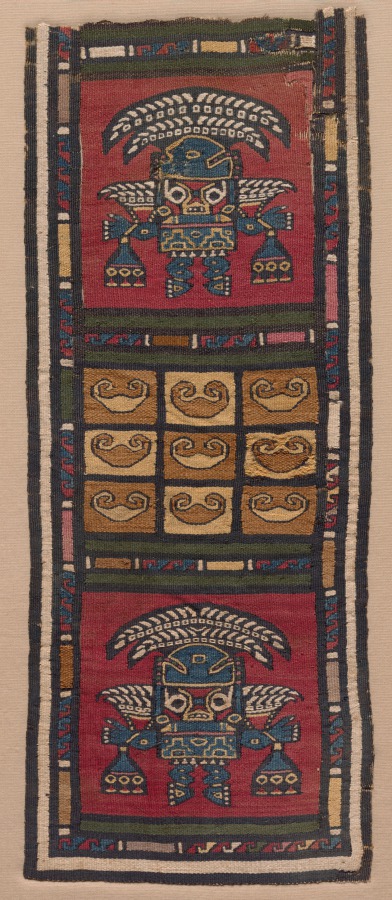
Tapestry Fragment (700–1370s) is in the Cleveland Museum of Art collection.
The work and its context
The museum's open-access catalogue describes the work:
The prominent figure with an elaborate headdress duplicated on this brightly colored fragment is known today as a “Lord,” a term that reveals uncertainty about his identity but confidence in his prestige. Whether a king or a deity, he was crucially important to the north coast Lambayeque (lahm-buy-YEK-kay) (Sicán) people, who often portrayed him in a wide range of media. The geometric motif that repeats in the nine central squares is unidentified.
Object facts
- Title: Tapestry Fragment
- Date: 700–1370s
- Culture: Peru, North Coast, Lambayeque (Sicán) people
- Type: Tapestry
- Technique: camelid fiber and cotton, tapestry weave
- Dimensions: Overall: 40 x 16.2 cm (15 3/4 x 6 3/8 in.); Mounted: 49.5 x 16.2 cm (19 1/2 x 6 3/8 in.)
- Collection: T - Pre-Columbian
- Department: Textiles
- Accession number: 1991.223
Collection credit
John L. Severance Fund
View the collection record
See the museum's photographs and full catalogue entry. Catalogue text is reproduced from the Cleveland Museum of Art's open-access data, with HTML formatting removed. This object and its supplied image are designated CC0.
Sources
More in Lifestyle
Keep reading
Related stories