Tapestry Panel (1000–1460s): Art, History and Details
Tapestry Panel at the Cleveland Museum of Art: 1000–1460s, camelid fiber and cotton, tapestry weave. Explore the work's context, creator attribution and collection history.
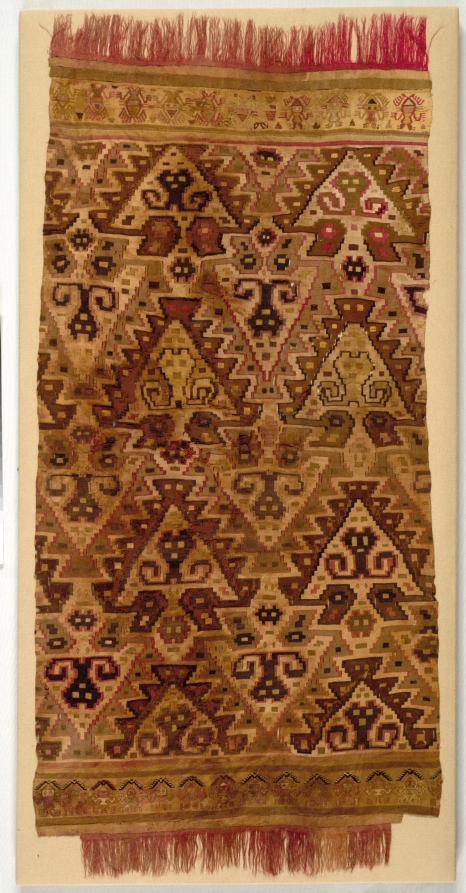
Tapestry Panel (1000–1460s) is in the Cleveland Museum of Art collection.
The work and its context
The museum's open-access catalogue describes the work:
The design of this panel depends on the repetition of a single motif: a small, geometricized head set inside a stepped V, which seems to represent the stylized bodies and wings of two birds. This motif, woven in different color combinations, alternates between up and down to form a sophisticated interlocking pattern that has no proper top and bottom. The panel probably once belonged to a garment.
Object facts
- Title: Tapestry Panel
- Date: 1000–1460s
- Culture: Peru, Central Coast, Chancay-Chimú style, 11th-15th century
- Type: Tapestry
- Technique: camelid fiber and cotton, tapestry weave
- Dimensions: Overall: 115 x 54.3 cm (45 1/4 x 21 3/8 in.); Mounted: 124.5 x 64.8 cm (49 x 25 1/2 in.)
- Collection: T - Pre-Columbian
- Department: Textiles
- Accession number: 1992.103
Collection credit
Seventy-fifth anniversary gift of Mr. and Mrs. Cedric Marks
Further reading listed by the museum
- Turner, Evan H. “The Year in Review for 1992.” The Bulletin of the Cleveland Museum of Art 80, no. 2 (February 1993): 38–79.
View the collection record
See the museum's photographs and full catalogue entry. Catalogue text is reproduced from the Cleveland Museum of Art's open-access data, with HTML formatting removed. This object and its supplied image are designated CC0.
Sources
More in Lifestyle
Keep reading