Tathagata Buddha (late 1800s): Art, History and Details
Tathagata Buddha at the Cleveland Museum of Art: late 1800s, hanging scroll; ink and color on paper. Explore the work's context, creator attribution and collection history.
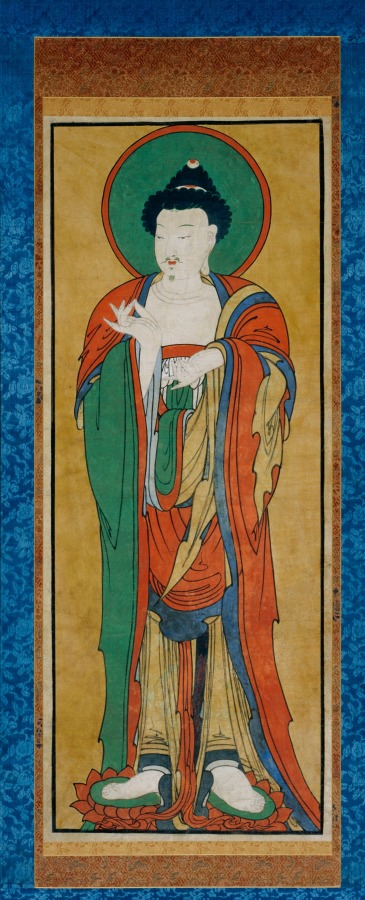
Tathagata Buddha (late 1800s) is in the Cleveland Museum of Art collection.
The work and its context
The museum's open-access catalogue describes the work:
Buddhist paintings of the late Joseon period (from the 17th to the 19th century) have several characteristics different from their precedents. Generally, they were painted in bright mineral pigments on either thick paper or hemp. This large painting, which measures more than 2 meters tall, used to serve as a banner for outdoor Buddhist ceremonies such as the water-and-land rite (水陸會).
Object facts
- Title: Tathagata Buddha
- Date: late 1800s
- Culture: Korea, Joseon dynasty (1392–1910)
- Type: Painting
- Technique: hanging scroll; ink and color on paper
- Dimensions: Overall: 214 x 69.4 cm (84 1/4 x 27 5/16 in.)
- Collection: ASIAN - Hanging scroll
- Department: Korean Art
- Accession number: 1918.542
A detail from the museum
The term Tathāgata can be understood as both "one who has thus gone" and "one who has thus come."
Collection credit
Worcester R. Warner Collection
Further reading listed by the museum
- Cunningham, Michael R. "The Korean Art Collection at the Cleveland Museum of Art: The Early Years." Korean Culture [= Hanʼguk munhwa]17, no. 2 (Summer 1986): p. 28.
- Treasures from Korea: Arts and Culture of the Joseon Dynasty, 1392-1910. Philadelphia: Philadelphia Museum of Art, 2014.
- Yi, Yong-yoon. “Bokjang Dedicated to Buddhist Paintings of the Late Joseon Period [조선후기 佛畵의 腹藏 연구].” Misulsahak yeongu (2016): 121–154.
View the collection record
See the museum's photographs and full catalogue entry. Catalogue text is reproduced from the Cleveland Museum of Art's open-access data, with HTML formatting removed. This object and its supplied image are designated CC0.
Sources
More in Lifestyle
Keep reading