Tea Whisk-Shaped Sake Bottle (1660s–early 1670s): Art, History and Details
Tea Whisk-Shaped Sake Bottle at the Cleveland Museum of Art: 1660s–early 1670s, Porcelain with overglaze enamel (Hizen ware, early iro-e). Explore the work's context, creator attribution and collection history.
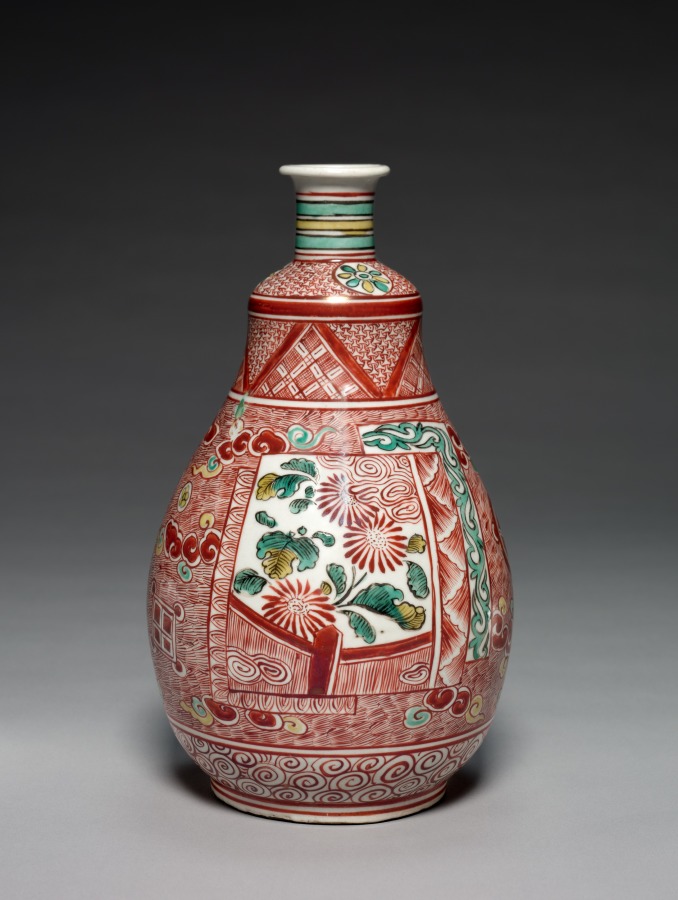
Tea Whisk-Shaped Sake Bottle (1660s–early 1670s) is in the Cleveland Museum of Art collection.
The work and its context
The museum's open-access catalogue describes the work:
This sake bottle resembles a whisk used in preparing powdered green tea, with the handle at the top and the body of the brush flaring out below. Its bold design is anchored by images of chrysanthemums and pomegranates set in panels against a ground of red hatching with tricolored clouds. Additional patterns of swirls, stripes, flowers, and other forms make the piece dazzling.
Object facts
- Title: Tea Whisk-Shaped Sake Bottle
- Date: 1660s–early 1670s
- Culture: Japan, Edo period (1615–1868)
- Type: Ceramic
- Technique: Porcelain with overglaze enamel (Hizen ware, early iro-e)
- Dimensions: height: 25.4 cm (10 in.); Diameter: 14.7 cm (5 13/16 in.)
- Collection: Japanese Art
- Department: Japanese Art
- Accession number: 2014.391
A detail from the museum
This bottle is for sake, or fermented rice wine, Japan's most famous variety of local alcohol.
Collection credit
Severance and Greta Millikin Purchase Fund
Further reading listed by the museum
- Archives of Asian Art. "Art of Asia Acquired by North American Museums, 2013–2014." Archives of Asian Art 65, no.1&2 (2015): 181–236.
- Maezaki, Shinya and Sinéad Vilbar. Colors of Kyoto: The Seifū Yohei Ceramic Studio. Cleveland, OH: The Cleveland Museum of Art, 2023.
View the collection record
See the museum's photographs and full catalogue entry. Catalogue text is reproduced from the Cleveland Museum of Art's open-access data, with HTML formatting removed. This object and its supplied image are designated CC0.
Sources
More in Lifestyle
Keep reading