Tent panel of a dragon slayer (1550–99): Art, History and Details
Tent panel of a dragon slayer at the Cleveland Museum of Art: 1550–99, velvet, cut, voided, brocaded, and pile-warp substitution: silk and gilt-metal strips. Explore the work's context, creator attribution and collection history.
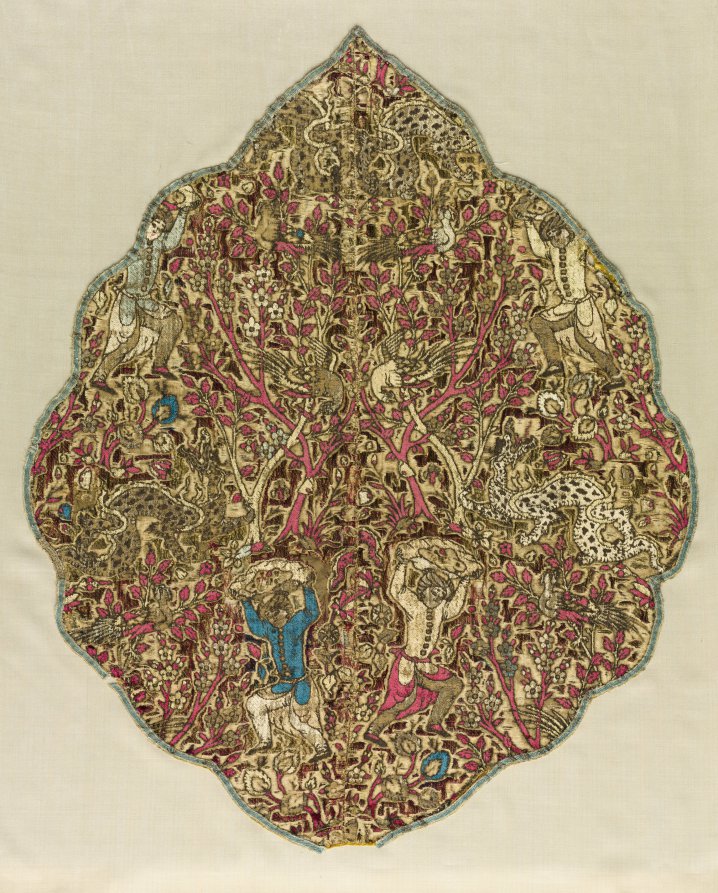
Tent panel of a dragon slayer (1550–99) is in the Cleveland Museum of Art collection.
The work and its context
The museum's open-access catalogue describes the work:
Iranian luxury textiles of the 16th and 17th centuries are renowned for representing human figures and for creating the most colorful velvets ever woven. Here, a dragon slayer dressed in 16th-century court attire is poised to hurl a boulder at a snarling dragon in a landscape with blossoming fruit trees and perched fowl. Even with faded silk pile this velvet contains many nuanced tones. As many as 12 colors of velvet pile were achieved by weavers who skillfully replaced colored pile warp during weaving. This velvet medallion decorated the interior of an imperial tent, possibly donated by Shah Tahmasp to an Ottoman Turkish sultan. Captured after the Ottoman siege of Vienna in 1683, the medallion was claimed as war booty by the European commander-in-chief Prince Sanguszko of Poland by whose name this and other panels are known.
Object facts
- Title: Tent panel of a dragon slayer
- Date: 1550–99
- Culture: Iran, Yazd[?], reign of Shah Tahmasp, Safavid period (1501-1736)
- Type: Velvet
- Technique: velvet, cut, voided, brocaded, and pile-warp substitution: silk and gilt-metal strips
- Dimensions: Overall: 71.1 x 55.6 cm (28 x 21 7/8 in.); Mounted: 81.3 x 66 cm (32 x 26 in.)
- Collection: T - Islamic
- Department: Textiles
- Accession number: 1948.205
A detail from the museum
Originally the ivory ground was covered with costly gilt-metal strips, which may have been removed for their monetary value.
Collection credit
Purchase from the J. H. Wade Fund
Further reading listed by the museum
- Royal Academy of Arts (Great Britain), and Arnold Talbot Wilson. Persian art: an illustrated souvenir of the exhibition of Persian art at Burlington house, London, 1931. [London]: Printed for the Executive Committee of the exhibition by Hudson & Kearns Ltd, 1931.
- Pope, Arthur Upham, Phyllis Ackerman, and Theodore Bestermann. A Survey of Persian Art from Prehistoric Times to the Present. London: Oxford University Press, 1938.
- Los Angeles County Museum. 2000 Years of Silk Weaving: An Exhibition Sponsored by the Los Angeles County Museum in Collaboration with the Cleveland Museum of Art and the Detroit Institute of Arts. New York: E. Weyhe, 1944.
View the collection record
See the museum's photographs and full catalogue entry. Catalogue text is reproduced from the Cleveland Museum of Art's open-access data, with HTML formatting removed. This object and its supplied image are designated CC0.
Sources
More in Lifestyle
Keep reading