Terpsichore Lyran (Muse of Lyric Poetry) (1816): Art, History and Details
Terpsichore Lyran (Muse of Lyric Poetry) at the Cleveland Museum of Art: 1816, marble. Explore the work's context, creator attribution and collection history.
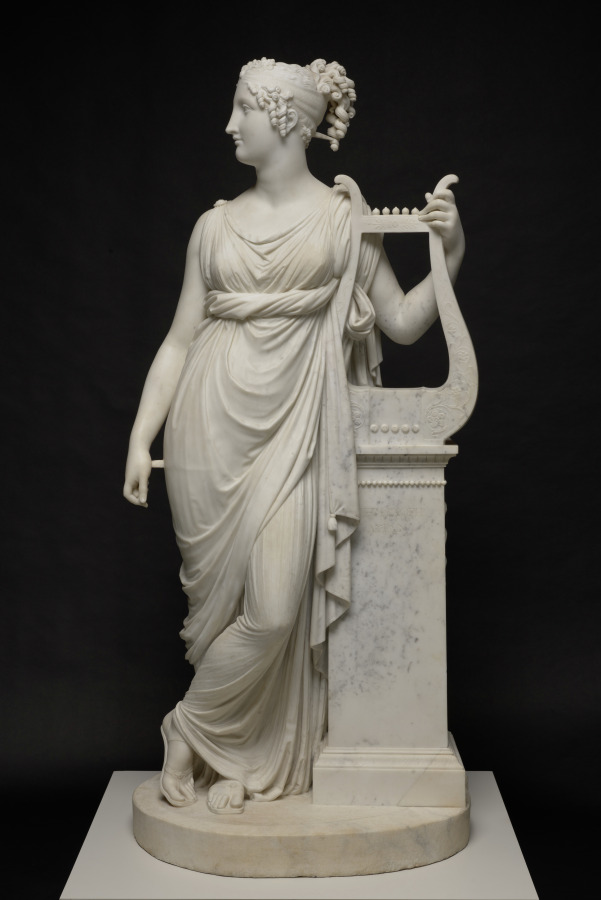
Terpsichore Lyran (Muse of Lyric Poetry) (1816) is in the Cleveland Museum of Art collection. The museum's creator attribution is Antonio Canova (Italian, 1757–1822).
The work and its context
The museum's open-access catalogue describes the work:
In Greek mythology, Terpsichore was one of the nine Muses, or goddesses of creative inspiration. The lyre, the Greek inscription on the short column, and the caduceus (entwined snakes) on the side identify the figure as Terpsichore Lyran, muse of lyric poetry. This sculpture began with a commission from Napoleon's brother, Lucien, for an idealized portrait of his wife, Alexandrine. Antonio Canova made this version for a British aristocrat and exhibited it in 1817 at the Royal Academy in London to great acclaim.
Object facts
- Title: Terpsichore Lyran (Muse of Lyric Poetry)
- Date: 1816
- Creator attribution: Antonio Canova (Italian, 1757–1822)
- Culture: Italy, 19th century
- Type: Sculpture
- Technique: marble
- Dimensions: Overall: 177.5 x 78.1 x 61 cm (69 7/8 x 30 3/4 x 24 in.)
- Collection: Mod Euro - Sculpture 1800-1960
- Department: Modern European Painting and Sculpture
- Accession number: 1968.212
A detail from the museum
Trained by his grandfather, an Italian stonemason, Canova began modeling clay and carving marble sculptures before age ten.
Collection credit
Leonard C. Hanna Jr. Fund
Further reading listed by the museum
- Teotochi Albrizzi, Isabella, Leopoldo Cicognara, and Henry Moses. The Works of Antonio Canova: In Sculpture and Modelling. London: S. Prowett, 1824.
- Lee, Sherman E. "The Year in Review for 1968." The Bulletin of the Cleveland Museum of Art 56, no. 1 (1969): 3-50.
- Honour, Hugh. "Canova's Statue of a Dancer." The National Gallery of Canada Bulletin Vol. 6, no. 1 (November 1968): 4-31.
View the collection record
See the museum's photographs and full catalogue entry. Catalogue text is reproduced from the Cleveland Museum of Art's open-access data, with HTML formatting removed. This object and its supplied image are designated CC0.
Sources
More in Lifestyle
Keep reading