Tetradrachm: Head of Apollo (obverse); Head of Lion (reverse) (466–422 BCE): Art, History and Details
Tetradrachm: Head of Apollo (obverse); Head of Lion (reverse) at the Cleveland Museum of Art: 466–422 BCE, silver. Explore the work's context, creator attribution and collection history.
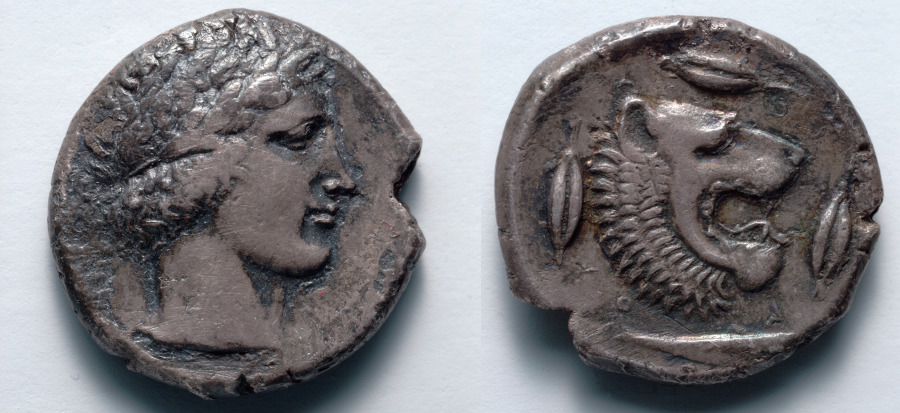
Tetradrachm: Head of Apollo (obverse); Head of Lion (reverse) (466–422 BCE) is in the Cleveland Museum of Art collection.
The work and its context
The museum's open-access catalogue describes the work:
The lion, king of the beasts and an animal associated with regal and heroic power, featured prominently on the coinage of many ancient Greek city-states. Artists placed the lion in a variety of poses, sometimes including the whole body, at other times the foreparts or just the head. Although it may once have roamed nearby, for many Greeks the lion was a monster nearly as exotic as the Chimaera, of which it formed a part, together with a goat head and snake-headed tail.
Object facts
- Title: Tetradrachm: Head of Apollo (obverse); Head of Lion (reverse)
- Date: 466–422 BCE
- Culture: Greek, minted at Leontinoi (Sicily)
- Type: Coins
- Technique: silver
- Dimensions: Diameter: 2.5 cm (1 in.)
- Collection: GR - Greek
- Department: Greek and Roman Art
- Accession number: 1917.988
A detail from the museum
The lion on coins of Leontini marks a pun on the city name.
Collection credit
Gift of the John Huntington Art and Polytechnic Trust
Further reading listed by the museum
- "Accessions." The Bulletin of the Cleveland Museum of Art 4, no. 4 (1917): 64-67.
View the collection record
See the museum's photographs and full catalogue entry. Catalogue text is reproduced from the Cleveland Museum of Art's open-access data, with HTML formatting removed. This object and its supplied image are designated CC0.
Sources
More in Lifestyle
Keep reading