Text, folio 12 (recto) from a Kammavacha: Buddhist ordination text (1800s): Art, History and Details
Text, folio 12 (recto) from a Kammavacha: Buddhist ordination text at the Cleveland Museum of Art: 1800s, Leaf: lacquer and gilding on cloth. Explore the work's context, creator attribution and collection history.
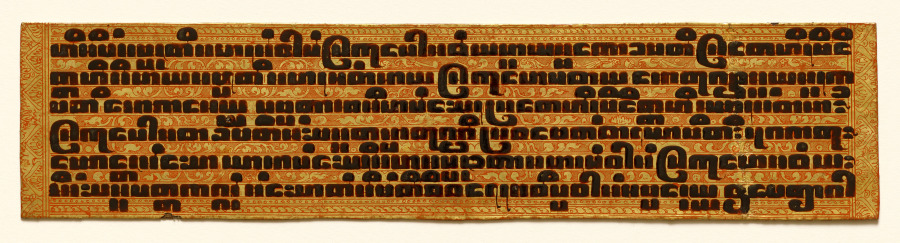
Text, folio 12 (recto) from a Kammavacha: Buddhist ordination text (1800s) is in the Cleveland Museum of Art collection.
The work and its context
The museum's open-access catalogue describes the work:
In premodern Burma, lay people commissioned lavishly ornamented manuscripts for ceremonial occasions, when officiants would read aloud from the text. Written in black lacquer, the text is in the language of Pali written in a Burmese script. It contains ordination rites and procedures for monastic ceremonies. The second to last page is covered with intricately drawn, winged celestial beings (nats) in gestures of praise. They fly amid intertwining vegetation—denoting bounty—that grows from serpentine forms that refer to rain clouds. Lionlike forms inhabit the space with them. The top and bottom covers are equally ornamented with jeweled floral patterning.
Object facts
- Title: Text, folio 12 (recto) from a Kammavacha: Buddhist ordination text
- Date: 1800s
- Culture: Myanmar (Burma)
- Type: Manuscript
- Technique: Leaf: lacquer and gilding on cloth
- Dimensions: Leaf: 12.8 x 56.1 cm (5 1/16 x 22 1/16 in.)
- Collection: Burmese Art
- Department: Indian and Southeast Asian Art
- Accession number: 1945.172.12.a
A detail from the museum
The Pali text of this manuscript is written in Burmese square script, which is also known as "tamarind seed script."
Collection credit
Edward L. Whittemore Fund
View the collection record
See the museum's photographs and full catalogue entry. Catalogue text is reproduced from the Cleveland Museum of Art's open-access data, with HTML formatting removed. This object and its supplied image are designated CC0.
Sources
More in Lifestyle
Keep reading