Textile fragment (Binakol) (c. early 1900s(?)): Art, History and Details
Textile fragment (Binakol) at the Cleveland Museum of Art: c. early 1900s(?), woven cotton; extended tabby weave. Explore the work's context, creator attribution and collection history.
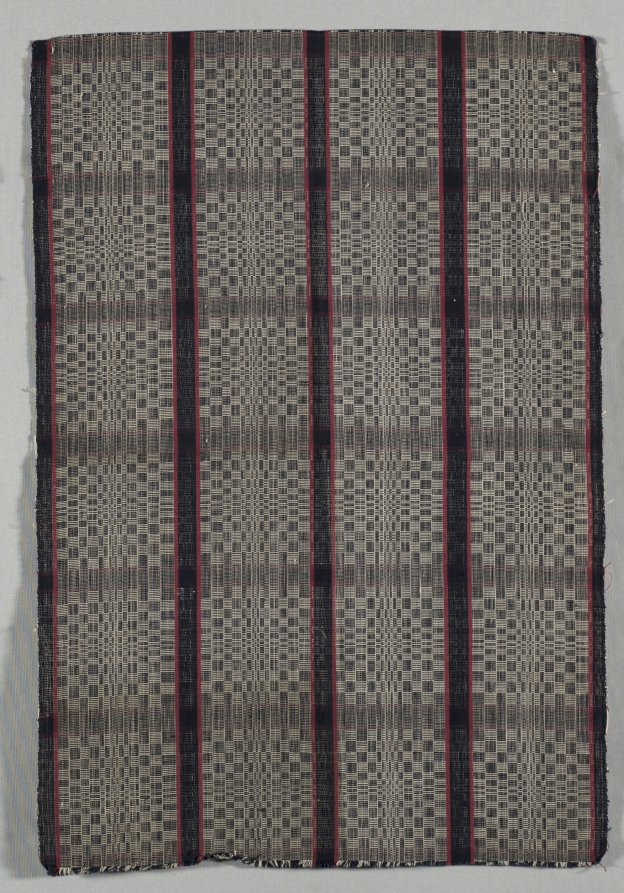
Textile fragment (Binakol) (c. early 1900s(?)) is in the Cleveland Museum of Art collection.
The work and its context
The museum's open-access catalogue describes the work:
This intricate, hand-woven textile was likely produced on a back-strap or upright loom. The binakol block pattern creates a strong optical effect, organized in vertical registers separated by broad, dark stripes with narrow, red accents. The central design is a variant of the whirlpool motif known as kusikos, in which alternating light and dark squares appear to spiral or recede.
Object facts
- Title: Textile fragment (Binakol)
- Date: c. early 1900s(?)
- Culture: Philippines, Ilokos, Norte Province, Luzon, 20th century(?)
- Type: Textile
- Technique: woven cotton; extended tabby weave
- Dimensions: Overall: 68.6 x 48.3 cm (27 x 19 in.)
- Collection: Textiles
- Department: Textiles
- Accession number: 1921.1596
A detail from the museum
The swirling kusikos pattern was meant to confuse evil spirits and had a protective function.
Collection credit
Gift of W. A. Price
View the collection record
See the museum's photographs and full catalogue entry. Catalogue text is reproduced from the Cleveland Museum of Art's open-access data, with HTML formatting removed. This object and its supplied image are designated CC0.
Sources
More in Lifestyle
Keep reading