Textile with Phoenixes and Dragons (1279–1368): Art, History and Details
Textile with Phoenixes and Dragons at the Cleveland Museum of Art: 1279–1368, Silk and gold thread; lampas. Explore the work's context, creator attribution and collection history.
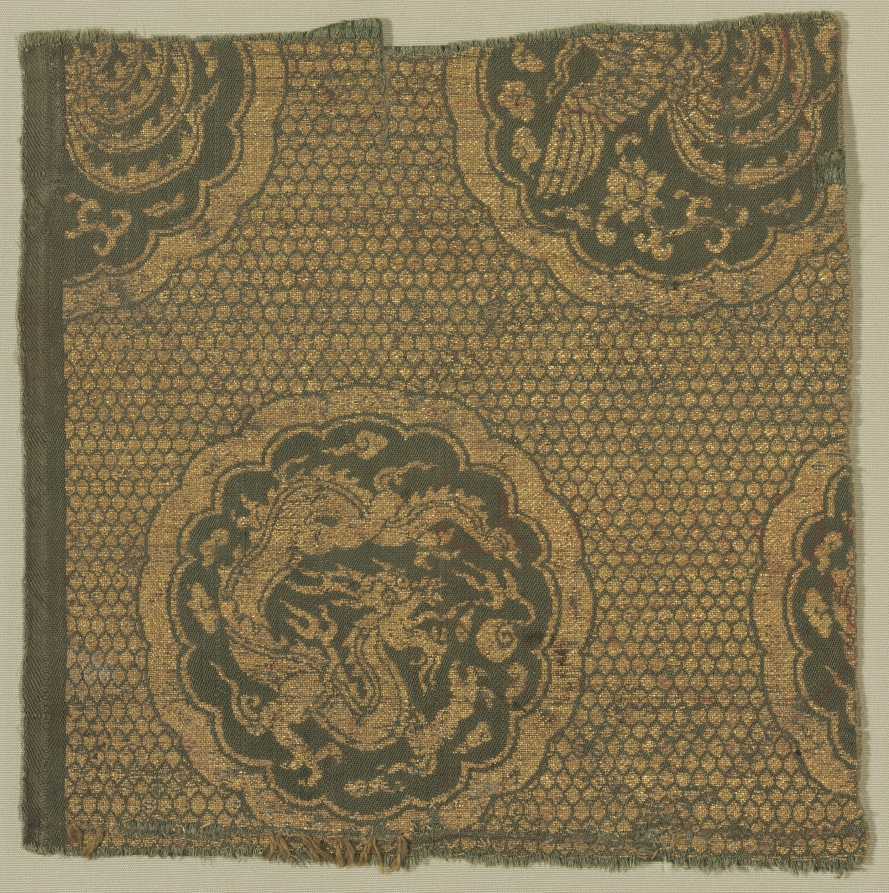
Textile with Phoenixes and Dragons (1279–1368) is in the Cleveland Museum of Art collection.
The work and its context
The museum's open-access catalogue describes the work:
This is one of the very few northern Chinese silk and gold textiles to have survived from the Yuan dynasty. The curled dragons chasing pearls, the phoenixes, and the background of tiny hexagons are Chinese motifs, but the lobed roundels enclosing the dragons and phoenixes indicate the influence of eastern Iranian craftsmen who had been relocated to northern China. A red and gold silk woven with the same pattern is preserved in Beijing. The extraordinary survival of the two silks demonstrates that patterns were typically used over and over.
Object facts
- Title: Textile with Phoenixes and Dragons
- Date: 1279–1368
- Culture: China, Yuan dynasty (1260-1368)
- Type: Textile
- Technique: Silk and gold thread; lampas
- Dimensions: Overall: 20.3 x 20 cm (8 x 7 7/8 in.); Mounted: 31.4 x 31.1 cm (12 3/8 x 12 1/4 in.)
- Collection: Textiles
- Department: Textiles
- Accession number: 1995.73
Collection credit
Edward L. Whittemore Fund
Further reading listed by the museum
- Watt, James C. Y., Anne E. Wardwell, and Morris Rossabi. When silk was gold: Central Asian and Chinese textiles. New York: Metropolitan Museum of Art in cooperation with the Cleveland Museum of Art, 1997.
- Komaroff, Linda, and Stefano Carboni. The Legacy of Genghis Khan: Courtly Art and Culture in Western Asia, 1256-1353. New York : Metropolitan Museum of Art ; New Haven : Yale University Press: 2002.
- Watt, James C. Y., and Maxwell K. Hearn. The World of Khubilai Khan: Chinese Art in the Yuan Dynasty. New York: Metropolitan Museum of Art, 2010.
View the collection record
See the museum's photographs and full catalogue entry. Catalogue text is reproduced from the Cleveland Museum of Art's open-access data, with HTML formatting removed. This object and its supplied image are designated CC0.
Sources
More in Lifestyle
Keep reading