Thalia (comedy, pastoral poetry) (from the Tarocchi series D: Apollo and the Muses, #16) (before 1467): Art, History and Details
Thalia (comedy, pastoral poetry) (from the Tarocchi series D: Apollo and the Muses, #16) at the Cleveland Museum of Art: before 1467, engraving hand-colored with gold. Explore the work's context, creator attribution and collection history.
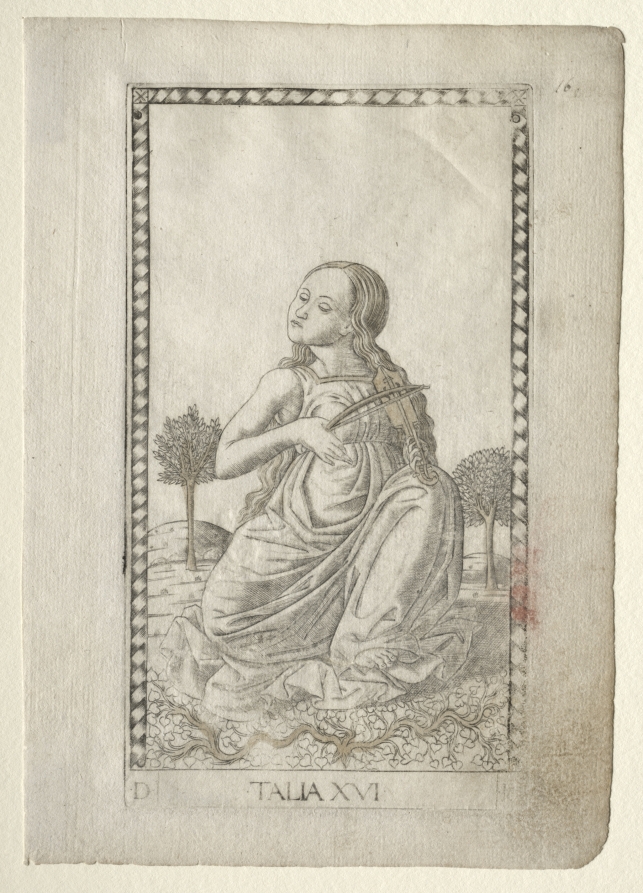
Thalia (comedy, pastoral poetry) (from the Tarocchi series D: Apollo and the Muses, #16) (before 1467) is in the Cleveland Museum of Art collection. The museum's creator attribution is Master of the E-Series Tarocchi (Italian, active 1460s).
The work and its context
The museum's open-access catalogue describes the work:
This engraving is part of the Tarocchi group marked with the letter “D,” and named Apollo and the Muses. In Greek mythology, the nine Muses (Calliope, Urania, Terpsichore, Erato, Polyhymnia, Thalia, Melpomene, Euterpe, and Clio) were the daughters of Zeus, king of the gods, and Mnemosyne, the Titaness of memory. The Muses were goddesses presiding over different branches of the arts and sciences. Their leader and supervisor was Apollo, the god of light, music, prophecy, and poetry. Here, Talia (Thalia) is personified as a female figure, in profile to left, seated on ivy, and set an imaginary landscape. She is playing a viola. Thalia was regarded as the Muse of comedy.
Object facts
- Title: Thalia (comedy, pastoral poetry) (from the Tarocchi series D: Apollo and the Muses, #16)
- Date: before 1467
- Creator attribution: Master of the E-Series Tarocchi (Italian, active 1460s)
- Culture: Italy, Ferrara, 15th century
- Type: Print
- Technique: engraving hand-colored with gold
- Collection: PR - Engraving
- Department: Prints
- Accession number: 1924.432.16
A detail from the museum
Thalia is the only Muse in the Tarocchi series that is not represented with a celestial disk. Indeed, Thalia was believed to be a bucolic Muse, thus related to earth.
Collection credit
Dudley P. Allen Fund
View the collection record
See the museum's photographs and full catalogue entry. Catalogue text is reproduced from the Cleveland Museum of Art's open-access data, with HTML formatting removed. This object and its supplied image are designated CC0.
Sources
More in Lifestyle
Keep reading