The Abduction of a Sabine Woman (1584): Art, History and Details
The Abduction of a Sabine Woman at the Cleveland Museum of Art: 1584, chiaroscuro woodcut. Explore the work's context, creator attribution and collection history.
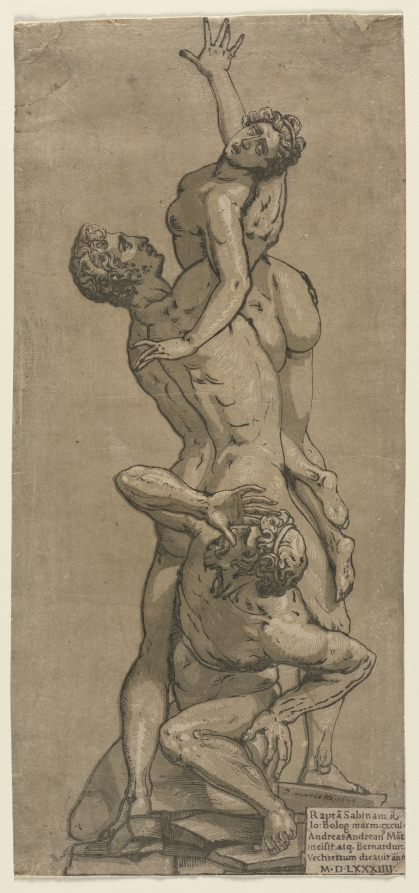
The Abduction of a Sabine Woman (1584) is in the Cleveland Museum of Art collection. The museum's creator attribution is Andrea Andreani (Italian, about 1558–1610); Giambologna (Flemish, active Italy, 1529–1608).
The work and its context
The museum's open-access catalogue describes the work:
A pinnacle of sculpture in the generation after Michelangelo was Giambologna’s Abduction of the Sabine Women, depicted here in a contemporaneous print by Andrea Andreani. Giambologna created a twisting harmony of three forms that capture the narrative of a Roman male abducting a Sabine woman and vanquishing a Sabine male below. Giambologna’s sculpture was installed in Florence in the public piazza near Michelangelo’s David.
Object facts
- Title: The Abduction of a Sabine Woman
- Date: 1584
- Creator attribution: Andrea Andreani (Italian, about 1558–1610); Giambologna (Flemish, active Italy, 1529–1608)
- Culture: Italy
- Type: Print
- Technique: chiaroscuro woodcut
- Collection: PR - Chiaroscuro
- Department: Prints
- Accession number: 1925.1221
A detail from the museum
The Abduction of a Sabine Woman is the first attempt in the chiaroscuro technique by Andrea Andreani, as well as the first chiaroscuro ever to depict a work of sculpture.
Collection credit
Gift of The Print Club of Cleveland
Further reading listed by the museum
- Goldfarb, Hilliard T. “Chiaroscuro Woodcut Technique and Andrea Andreani.” The Bulletin of the Cleveland Museum of Art 68, no. 9 (November 1981): 307–330.
View the collection record
See the museum's photographs and full catalogue entry. Catalogue text is reproduced from the Cleveland Museum of Art's open-access data, with HTML formatting removed. This object and its supplied image are designated CC0.
Sources
More in Lifestyle
Keep reading