The "Apostles" Pyx (Box) (c. 980–1010): Art, History and Details
The "Apostles" Pyx (Box) at the Cleveland Museum of Art: c. 980–1010, ivory. Explore the work's context, creator attribution and collection history.
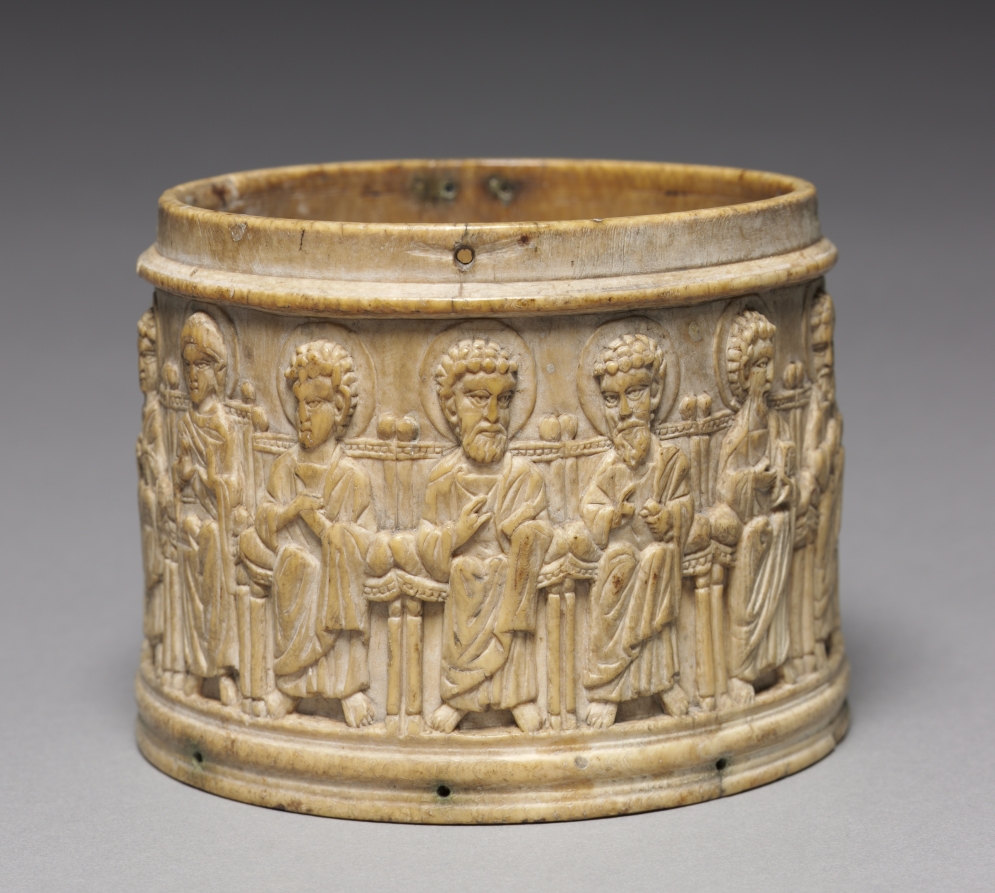
The "Apostles" Pyx (Box) (c. 980–1010) is in the Cleveland Museum of Art collection. The museum's creator attribution is Triptych Group.
The work and its context
The museum's open-access catalogue describes the work:
This pyx shows Christ as Pantokrator (Ruler of the World), the Apostles, and the Virgin as a continuous frieze of figures seated in high-backed chairs with cushions. The tapered lip of the body of the pyx was intended to dovetail into the missing lid. Because of its style, the box is thought to be from a workshop of ivory carvers called "The Triptych Group" active in Constantinople between about 950 and 1010. This is the only known pyx to survive from the Middle Byzantine period (about ad 843-1204).
Object facts
- Title: The "Apostles" Pyx (Box)
- Date: c. 980–1010
- Creator attribution: Triptych Group
- Culture: Byzantium, Constantinople, middle Byzantine period, 10th-11th century
- Type: Ivory
- Technique: ivory
- Dimensions: Overall: 25.5 x 17.5 cm (10 1/16 x 6 7/8 in.)
- Collection: MED - Byzantine
- Department: Medieval Art
- Accession number: 1973.4
Collection credit
Purchase from the J. H. Wade Fund
Further reading listed by the museum
- “The Year in Review for 1973.” The Bulletin of the Cleveland Museum of Art 61, no. 2 (February 1974): 31–78.
- The Cleveland Museum of Art. Handbook of the Cleveland Museum of Art/1978. Cleveland, OH: The Cleveland Museum of Art, 1978.
- Evans, Helen C., and William D. Wixom. The Glory of Byzantium: Art and Culture of the Middle Byzantine Era, A.D. 843-1261. New York: Metropolitan Museum of Art, 1997.
View the collection record
See the museum's photographs and full catalogue entry. Catalogue text is reproduced from the Cleveland Museum of Art's open-access data, with HTML formatting removed. This object and its supplied image are designated CC0.
Sources
More in Lifestyle
Keep reading