The birth of Rama and his brothers, from Chapter 17 of the Bala Kanda (Book of Childhood) of the Adhyatma Ramayana (Rama's Journey of the Supreme Spirit) from the Brahmanda Purana (Ancient Scripture o
The birth of Rama and his brothers, from Chapter 17 of the Bala Kanda (Book of Childhood) of the Adhyatma Ramayana (Rama's Journey of the Supreme Spirit) from the Brahmanda Purana (Ancient Scripture of the Cosmic Egg) at the Cleveland Museu
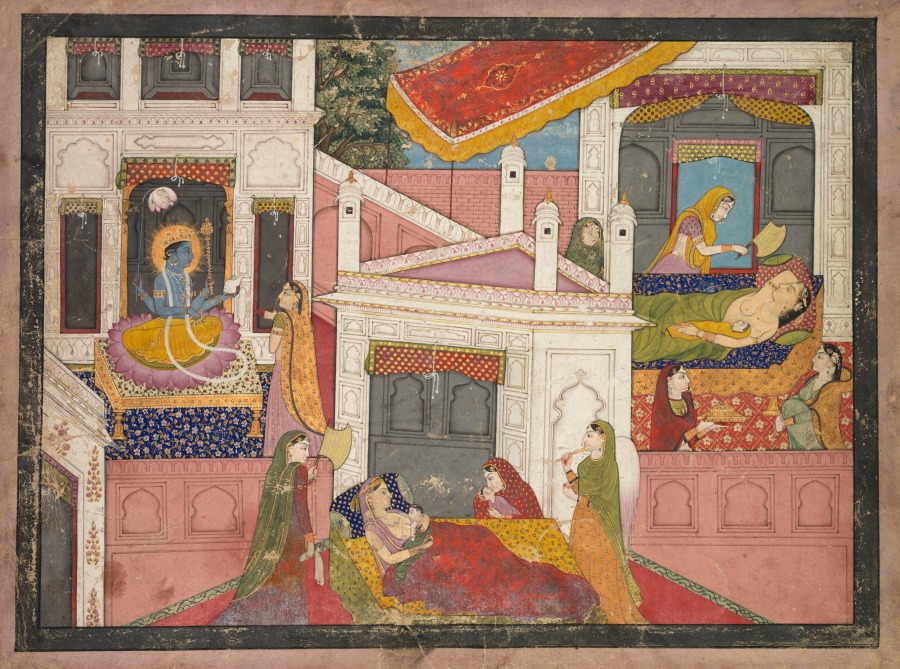
The birth of Rama and his brothers, from Chapter 17 of the Bala Kanda (Book of Childhood) of the Adhyatma Ramayana (Rama's Journey of the Supreme Spirit) from the Brahmanda Purana (Ancient Scripture of the Cosmic Egg) (c. 1820–30) is in the Cleveland Museum of Art collection.
The work and its context
The museum's open-access catalogue describes the work:
In a retelling of the Ramayana from the 1200s, the blue god Vishnu appears in a vision to Queen Kaushalya just before she gives birth to his incarnation as Rama. In the foreground, her co-wife Queen Sumitra nurses one of her own newborn twins, Lakshmana and Shatrughna. Rama’s half-brother Bharata lies swaddled next to his mother Queen Kaikeyi on an adjacent terrace of the women’s quarters. The patterned carvings and textiles of the palace interior communicate the luxury into which the princes were born, and from which Rama and Lakshmana will be eventually exiled.
Object facts
- Title: The birth of Rama and his brothers, from Chapter 17 of the Bala Kanda (Book of Childhood) of the Adhyatma Ramayana (Rama's Journey of the Supreme Spirit) from the Brahmanda Purana (Ancient Scripture of the Cosmic Egg)
- Date: c. 1820–30
- Culture: Northern India, Pahari Region, Himachal Pradesh, Rajput Kingdom of Kangra, Court of Aniruddh Chand (reigned 1823–33)
- Type: Painting
- Technique: Gum tempera, ink, and gold on paper
- Dimensions: Painting: 25.1 x 34 cm (9 7/8 x 13 3/8 in.); Overall: 29.9 x 38.5 cm (11 3/4 x 15 3/16 in.)
- Collection: Indian Art
- Department: Indian and Southeast Asian Art
- Accession number: 1953.13
A detail from the museum
King Dasharatha thought his wife Kaikeyi, shown sleeping, was the most beautiful of his three wives.
Collection credit
Edward L. Whittemore Fund
Further reading listed by the museum
- Boger, Ann C., and Joellin K. DeOreo. Sacred India: Hinduism, Buddhism, and Jainism. Cleveland: Cleveland Museum of Art in cooperation with Indiana University Press, 1985.
- Ward, William E. "Three Indian Paintings." The Bulletin of the Cleveland Museum of Art 42, no. 1 (Jan. 1955): 12–15.
- Leach, Linda York. Indian Miniature Paintings and Drawings. Cleveland, OH: Cleveland Museum of Art in cooperation with Indiana University Press, 1986.
View the collection record
See the museum's photographs and full catalogue entry. Catalogue text is reproduced from the Cleveland Museum of Art's open-access data, with HTML formatting removed. This object and its supplied image are designated CC0.
Sources
- The birth of Rama and his brothers, from Chapter 17 of the Bala Kanda (Book of Childhood) of the Adhyatma Ramayana (Rama's Journey of the Supreme Spirit) from the Brahmanda Purana (Ancient Scripture of the Cosmic Egg) (c. 1820–30; Cleveland 1953.13) — Cleveland Museum of Art
- Cleveland Museum of Art Open Access
More in Lifestyle
Keep reading