The Brahman gives an account of his falling in love with the king of Babylon’s daughter to his friend, the magician, from a Tuti-nama (Tales of a Parrot): Thirty-fifth Night (c. 1560): Art, History an
The Brahman gives an account of his falling in love with the king of Babylon’s daughter to his friend, the magician, from a Tuti-nama (Tales of a Parrot): Thirty-fifth Night at the Cleveland Museum of Art: c. 1560, gum tempera, ink, and gol
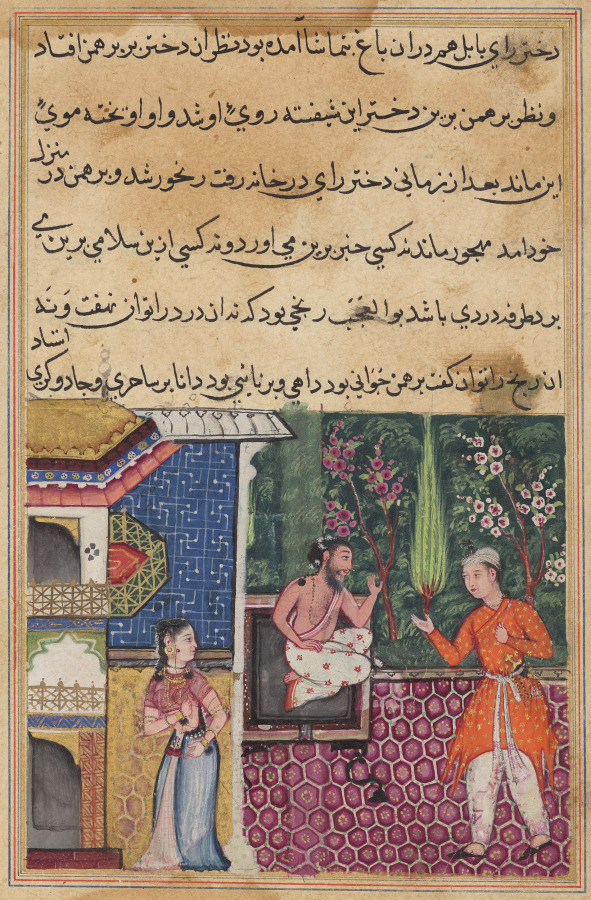
The Brahman gives an account of his falling in love with the king of Babylon’s daughter to his friend, the magician, from a Tuti-nama (Tales of a Parrot): Thirty-fifth Night (c. 1560) is in the Cleveland Museum of Art collection.
The work and its context
The museum's open-access catalogue describes the work:
The figure in orange is a magician addressing a seated Brahman—a member of India’s Hindu priestly class—who has come to him for help. He and the princess of Babylon have fallen in love and want to be together, but she is sequestered in the palace harem. The magician transformed the Brahman into a woman, shown at left, walking toward the palace. This is an example of continuous narration, in which two scenes are depicted in the same picture plane. The garden with flowering trees in the background evokes the setting where the Brahman and the princess met and fell in love.
Object facts
- Title: The Brahman gives an account of his falling in love with the king of Babylon’s daughter to his friend, the magician, from a Tuti-nama (Tales of a Parrot): Thirty-fifth Night
- Date: c. 1560
- Culture: Mughal India, court of Akbar (reigned 1556–1605)
- Type: Painting
- Technique: gum tempera, ink, and gold on paper
- Dimensions: Overall: 20.3 x 14 cm (8 x 5 1/2 in.); Painting only: 9.7 x 10.2 cm (3 13/16 x 4 in.)
- Collection: Indian Art
- Department: Indian and Southeast Asian Art
- Accession number: 1962.279.231.b
A detail from the museum
Brahmans wear a sacred thread across their upper bodies, over the left shoulder and under the right arm.
Collection credit
Gift of Mrs. A. Dean Perry
Further reading listed by the museum
- Chandra, Pramod, and Daniel J. Ehnbom. The Cleveland Tuti-Nama Manuscript and the Origins of Mughal Painting. [Cleveland]: Cleveland Museum of Art, 1976.
- Seyller, John. “Overpainting in the Cleveland T̤ūtīnāma.” Artibus Asiae 52, no. 3/4 (1992): 283-318.
View the collection record
See the museum's photographs and full catalogue entry. Catalogue text is reproduced from the Cleveland Museum of Art's open-access data, with HTML formatting removed. This object and its supplied image are designated CC0.
Sources
More in Lifestyle
Keep reading