The Cleveland Apollo: Apollo Sauroktonos (Lizard-Slayer) or Apollo the Python-Slayer (c. 350–200 BCE): Art, History and Details
The Cleveland Apollo: Apollo Sauroktonos (Lizard-Slayer) or Apollo the Python-Slayer at the Cleveland Museum of Art: c. 350–200 BCE, bronze, copper, and stone inlay. Explore the work's context, creator attribution and collection history.
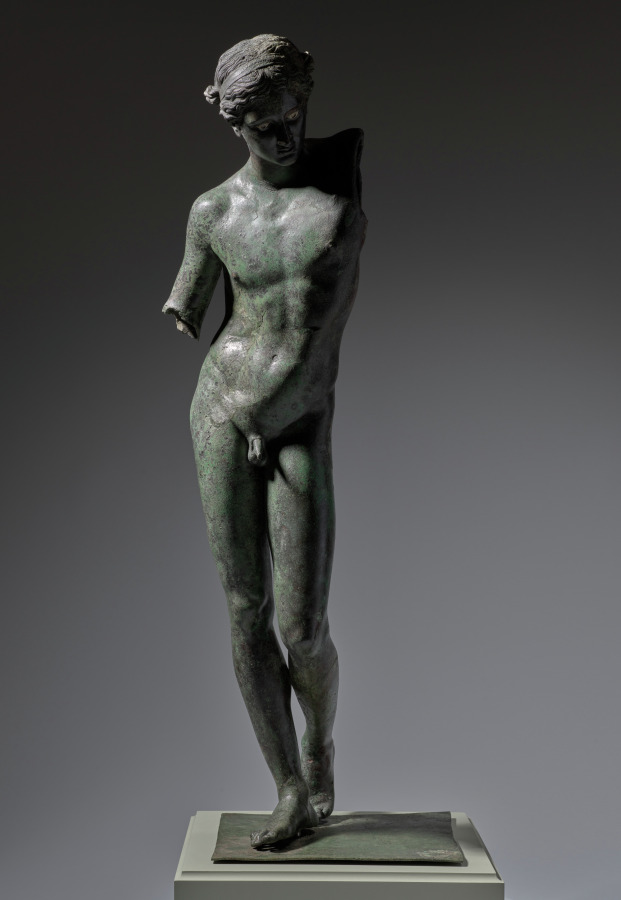
The Cleveland Apollo: Apollo Sauroktonos (Lizard-Slayer) or Apollo the Python-Slayer (c. 350–200 BCE) is in the Cleveland Museum of Art collection. The museum's creator attribution is Praxiteles (Greek, Athenian, c. 400–330 BCE); Follower.
The work and its context
The museum's open-access catalogue describes the work:
The Cleveland Apollo has been called both Lizard-Slayer (Sauroktonos) and Python-Slayer. The first name comes from the Roman author Pliny the Elder (23–79 CE), who noted in describing bronze works made by the Athenian sculptor Praxiteles (active around 370–330 BCE), “the youthful Apollo [is] known as the Sauroktonos because he is aiming an arrow at a lizard [Greek sauros] which is stealing toward him.” Scholars have long connected this description with artworks showing the young Greek god Apollo in a distinctive pose and hairstyle, standing on his right leg and leaning to his left. In more completely preserved versions, Apollo reaches toward a tree with his left arm and seems to take aim at a lizard. The Cleveland Apollo shows the adolescent god similarly posed and coiffed, making it an important addition to the Apollo Sauroktonos group—the only surviving large-scale bronze sculpture of the type. The young Greek god Apollo, identifiable by his distinctive hairstyle and pose, stands on his right leg and leans to his left, probably toward a now-lost tree. Although now separated, the left forearm and hand survive, together with an unusual lizard-like creature, perhaps drawn from the world of myth. A flat bronze base also remains, though it may be a later adaptation. A tree or other support has been lost, probably smaller than in the marble versions. Given its material and very high artistic quality—note the lifelike hair, fingernails, and inlaid copper lips and nipples—more than one scholar has suggested that the Cleveland Apollo could be the very sculpture seen by Pliny. Some have called the sculpture “Python-Slayer,” seeing the oddly shaped serpentine creature with asymmetrical legs as the mythical Python killed by Apollo in establishing his sanctuary at Delphi. But technical details may explain some of the asymmetry, and no other specific evidence connects it to Delphi. Most scholars would retain the name Sauroktonos (Lizard-Slayer) for the Cleveland Apollo, even as some debate whether it was made by Praxiteles himself or a later follower.
Object facts
- Title: The Cleveland Apollo: Apollo Sauroktonos (Lizard-Slayer) or Apollo the Python-Slayer
- Date: c. 350–200 BCE
- Creator attribution: Praxiteles (Greek, Athenian, c. 400–330 BCE); Follower
- Culture: Greece, Athens
- Type: Sculpture
- Technique: bronze, copper, and stone inlay
- Dimensions: Base: 0.5 x 47.3 x 40.7 cm (3/16 x 18 5/8 x 16 in.); Overall: 150 x 50.3 x 66.8 cm (59 1/16 x 19 13/16 x 26 5/16 in.)
- Collection: GR - Greek
- Department: Greek and Roman Art
- Accession number: 2004.30
A detail from the museum
The Cleveland Apollo is the only surviving large-scale bronze sculpture of its type, Apollo Sauroktonos (the Lizard-Slayer).
Collection credit
Severance and Greta Millikin Purchase Fund
Further reading listed by the museum
- "Original, copie, représentation antique? Quleques considérations sur les images d'Apollo Sauroktonos," in eds. Colloque international sur les bronzes antiques, Crişan Muçeţeanu, Lucia Teposu Marinescu, Christina Ştirbulescu, and Valentin Bottez, The Antique bronzes typology, chronology, authenticity : the acta of the 16the International Congress of Antique Bronzes organised by the Romanian National History Museum, Bucharest, May 26th-31st 2003 (Bucharest: Cetatea de Scaun, 2004), pp. 301-304.
- Bennett, Michael. "The Cleveland Apollo." Cleveland Art: Cleveland Museum of Art Members Magazine 44, no. 7 (September 2004): 4-5.
- "Acquisitions of the year," Apollo: The International Magazine of Art and Antiques. (December 2004).
View the collection record
See the museum's photographs and full catalogue entry. Catalogue text is reproduced from the Cleveland Museum of Art's open-access data, with HTML formatting removed. This object and its supplied image are designated CC0.
Sources
More in Lifestyle
Keep reading