The Crucifixion (c. 1290–1320): Art, History and Details
The Crucifixion at the Cleveland Museum of Art: c. 1290–1320, ivory. Explore the work's context, creator attribution and collection history.
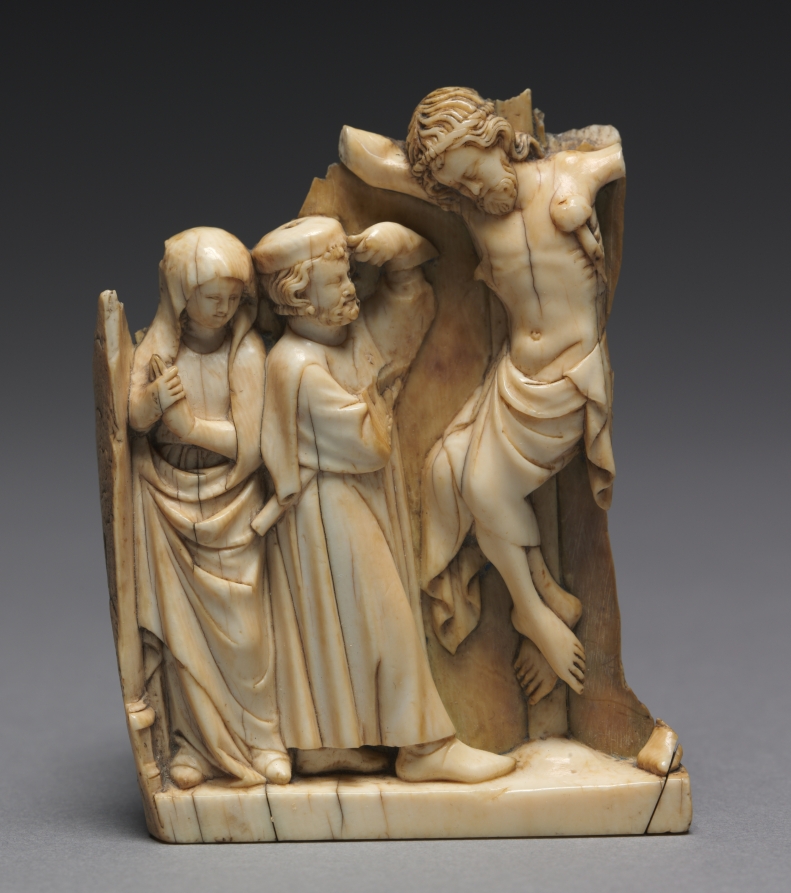
The Crucifixion (c. 1290–1320) is in the Cleveland Museum of Art collection.
The work and its context
The museum's open-access catalogue describes the work:
Flanking the crucified Christ, the figures of Longinus and the Virgin appear on this fragment of an exquisitely carved ivory panel. Now lost are the figures of Stephaton and Saint John. However, Stephaton’s right foot and the vinegar-soaked sponge on a pole are still visible where the ivory breaks off.
Object facts
- Title: The Crucifixion
- Date: c. 1290–1320
- Culture: France, Paris?, Gothic period, late 13th-early 14th century
- Type: Ivory
- Technique: ivory
- Dimensions: Overall: 8.5 x 6.4 x 1.2 cm (3 3/8 x 2 1/2 x 1/2 in.)
- Collection: MED - Gothic
- Department: Medieval Art
- Accession number: 1978.55
Collection credit
Gift of Dr. Norman Zaworski
Further reading listed by the museum
- Lee, Sherman E. “The Year in Review for 1978.” The Bulletin of the Cleveland Museum of Art 66, no. 1 (January 1979): 3–48.
- Wixom, William D. “Eleven Additions to the Medieval Collection.” The Bulletin of the Cleveland Museum of Art 66, no. 3 (Mar/Apr 1979): 87–151.
- Chiesi, Benedetta. "Avori Gotici." In Gli Avori del Museo Nazionale del Bargello, edited by Ilaria Ciseri, 199-332. Milano, Italia: Officina Libraria, 2018.
View the collection record
See the museum's photographs and full catalogue entry. Catalogue text is reproduced from the Cleveland Museum of Art's open-access data, with HTML formatting removed. This object and its supplied image are designated CC0.
Sources
More in Lifestyle
Keep reading
Related stories