The daughter-in-law of the king of Banaras, charmed by the music of a vagabond, comes down to meet him, from a Tuti-nama (Tales of a Parrot): Sixteenth Night (c. 1560): Art, History and Details
The daughter-in-law of the king of Banaras, charmed by the music of a vagabond, comes down to meet him, from a Tuti-nama (Tales of a Parrot): Sixteenth Night at the Cleveland Museum of Art: c. 1560, gum tempera, ink, and gold on paper. Expl
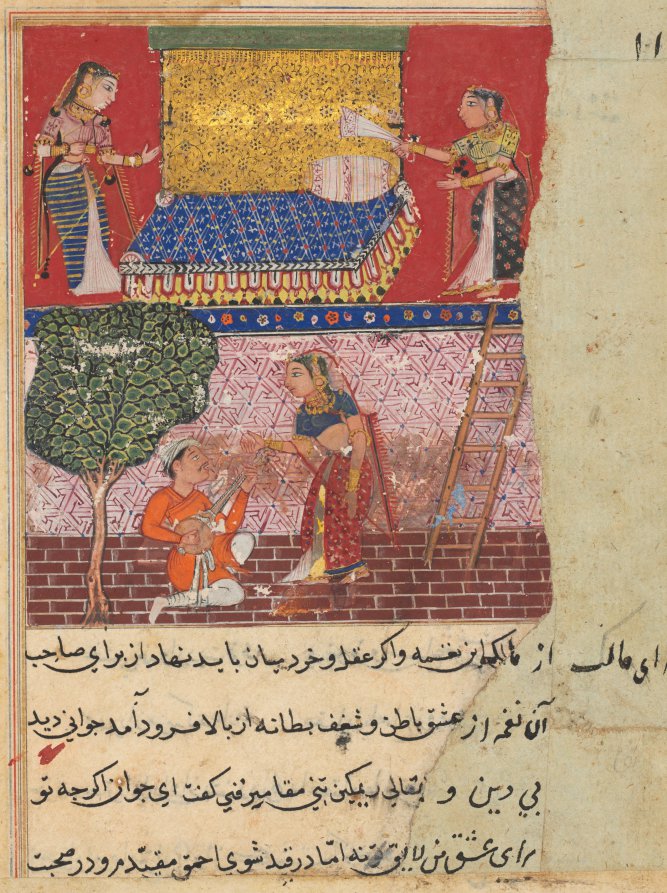
The daughter-in-law of the king of Banaras, charmed by the music of a vagabond, comes down to meet him, from a Tuti-nama (Tales of a Parrot): Sixteenth Night (c. 1560) is in the Cleveland Museum of Art collection.
The work and its context
The museum's open-access catalogue describes the work:
A ladder connects the daughter-in-law’s chambers to the courtyard below, where the vagabond kneels beneath a tree, a stringed instrument called a rebab in hand, mouth open in song. Because her husband is unpleasant and ill-tempered, the woman falls in love with the musician. The damage to the right side of this page was probably repaired in the early 1800s.
Object facts
- Title: The daughter-in-law of the king of Banaras, charmed by the music of a vagabond, comes down to meet him, from a Tuti-nama (Tales of a Parrot): Sixteenth Night
- Date: c. 1560
- Culture: Mughal India, court of Akbar (reigned 1556–1605)
- Type: Painting
- Technique: gum tempera, ink, and gold on paper
- Dimensions: Overall: 20.3 x 14 cm (8 x 5 1/2 in.); Painting only: 11.2 x 9.9 cm (4 7/16 x 3 7/8 in.)
- Collection: Indian Art
- Department: Indian and Southeast Asian Art
- Accession number: 1962.279.119.b
A detail from the museum
The whereabouts of the previous folio, probably depicting the parrot addressing Khujasta on the sixteenth night, are unknown.
Collection credit
Gift of Mrs. A. Dean Perry
Further reading listed by the museum
- Chandra, Pramod, and Daniel J. Ehnbom. The Cleveland Tuti-Nama Manuscript and the Origins of Mughal Painting. [Cleveland]: Cleveland Museum of Art, 1976.
- Seyller, John. “Overpainting in the Cleveland T̤ūtīnāma.” Artibus Asiae 52, no. 3/4 (1992): 283-318.
View the collection record
See the museum's photographs and full catalogue entry. Catalogue text is reproduced from the Cleveland Museum of Art's open-access data, with HTML formatting removed. This object and its supplied image are designated CC0.
Sources
More in Lifestyle
Keep reading