The deceitful wife ejects the procuress after blackening her face, from a Tuti-nama (Tales of a Parrot): Eighth Night (c. 1560): Art, History and Details
The deceitful wife ejects the procuress after blackening her face, from a Tuti-nama (Tales of a Parrot): Eighth Night at the Cleveland Museum of Art: c. 1560, gum tempera, ink, and gold on paper. Explore the work's context, creator attribut
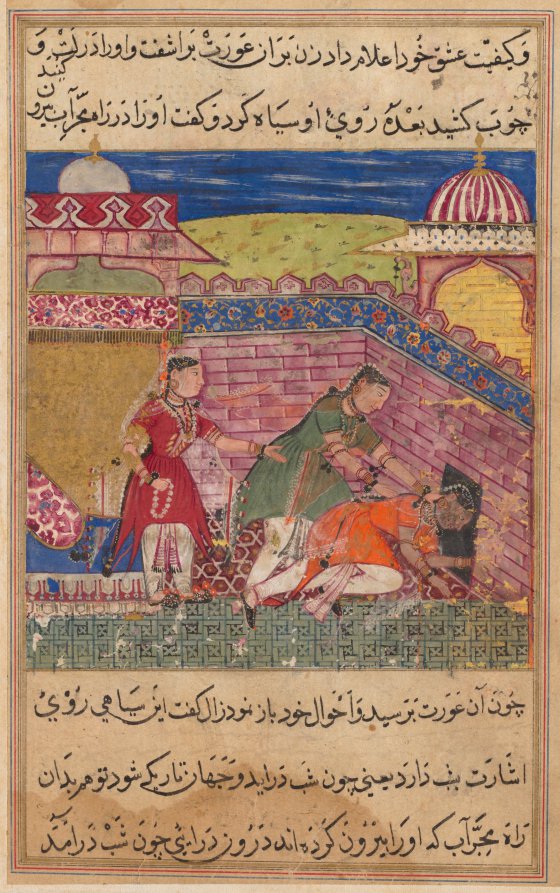
The deceitful wife ejects the procuress after blackening her face, from a Tuti-nama (Tales of a Parrot): Eighth Night (c. 1560) is in the Cleveland Museum of Art collection. The museum's creator attribution is Shravana (Indian, active 1550s–c.1600).
The work and its context
The museum's open-access catalogue describes the work:
The lover of the unfaithful wife sent a female messenger to arrange for their rendezvous. In a false display of horror, the wily adulteress blackened the face of the messenger as though to disgrace her and threw her out of the house, ordering her to be dumped by the side of a canal. That act, however, was a coded message to her lover to meet at the dark of night at that same location. The Indian artist Shravana added the pink brick wall to lend a sense of depth and dimensionality to the scene.
Object facts
- Title: The deceitful wife ejects the procuress after blackening her face, from a Tuti-nama (Tales of a Parrot): Eighth Night
- Date: c. 1560
- Creator attribution: Shravana (Indian, active 1550s–c.1600)
- Culture: Mughal India, court of Akbar (reigned 1556–1605)
- Type: Painting
- Technique: gum tempera, ink, and gold on paper
- Dimensions: Overall: 20.3 x 14 cm (8 x 5 1/2 in.); Painting only: 10.5 x 10 cm (4 1/8 x 3 15/16 in.)
- Collection: Indian Art
- Department: Indian and Southeast Asian Art
- Accession number: 1962.279.67.b
A detail from the museum
The striped dome and yellow bricks are vestiges of an earlier style of painting.
Collection credit
Gift of Mrs. A. Dean Perry
Further reading listed by the museum
- Chandra, Pramod, and Daniel J. Ehnbom. The Cleveland Tuti-Nama Manuscript and the Origins of Mughal Painting. [Cleveland]: Cleveland Museum of Art, 1976.
- Chandra, Pramod, and Daniel J. Ehnbom. The Cleveland Tuti-Nama Manuscript and the Origins of Mughal Painting. [Cleveland]: Cleveland Museum of Art, 1976.
- Seyller, John. “Overpainting in the Cleveland T̤ūtīnāma.” Artibus Asiae 52, no. 3/4 (1992): 283-318.
View the collection record
See the museum's photographs and full catalogue entry. Catalogue text is reproduced from the Cleveland Museum of Art's open-access data, with HTML formatting removed. This object and its supplied image are designated CC0.
Sources
More in Lifestyle
Keep reading