The Four Continents (1790): Art, History and Details
The Four Continents at the Cleveland Museum of Art: 1790, Cotton: copperplate printed. Explore the work's context, creator attribution and collection history.
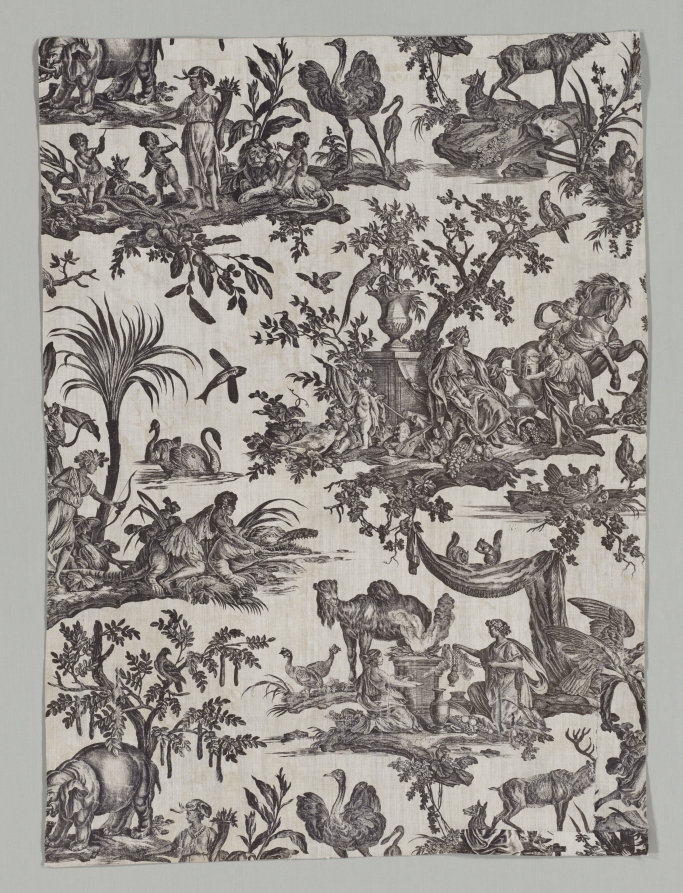
The Four Continents (1790) is in the Cleveland Museum of Art collection. The museum's creator attribution is Christophe Philippe Oberkampf (French, 1738–1815); Jean-Baptiste Marie Hüet (French, 1745–1811).
The work and its context
The museum's open-access catalogue describes the work:
Inspired by printed cottons from India, European manufacturers began printing textiles from copper plates in the 1750s. Originating in Ireland, the technique quickly spread to France where it flourished. Here, Jean-Baptiste Marie Huet I depicted female personifications of the four continents alongside their native flora and fauna. Although the artist based the plants and animals on real specimens observed at the Royal Botanical Gardens, he derived the personifications from racist stereotypes that imagined Europe as culturally superior: while Europe sits enthroned with symbols of the arts and knowledge at her feet, Africa wears an elephant headdress, America hunts an alligator, and Asia prays to a false god.
Object facts
- Title: The Four Continents
- Date: 1790
- Creator attribution: Christophe Philippe Oberkampf (French, 1738–1815); Jean-Baptiste Marie Hüet (French, 1745–1811)
- Culture: France
- Type: Textile
- Technique: Cotton: copperplate printed
- Dimensions: Overall: 112.1 x 81.3 cm (44 1/8 x 32 in.)
- Collection: Textiles
- Department: Textiles
- Accession number: 1929.6
A detail from the museum
Marie-Antoinette visited the textile factory where this design was made.
Collection credit
Gift of Gregor Norman Humphreys
View the collection record
See the museum's photographs and full catalogue entry. Catalogue text is reproduced from the Cleveland Museum of Art's open-access data, with HTML formatting removed. This object and its supplied image are designated CC0.
Sources
More in Lifestyle
Keep reading
Related stories