The French Soldier (Le Soldat français) (1818): Art, History and Details
The French Soldier (Le Soldat français) at the Cleveland Museum of Art: 1818, lithograph. Explore the work's context, creator attribution and collection history.
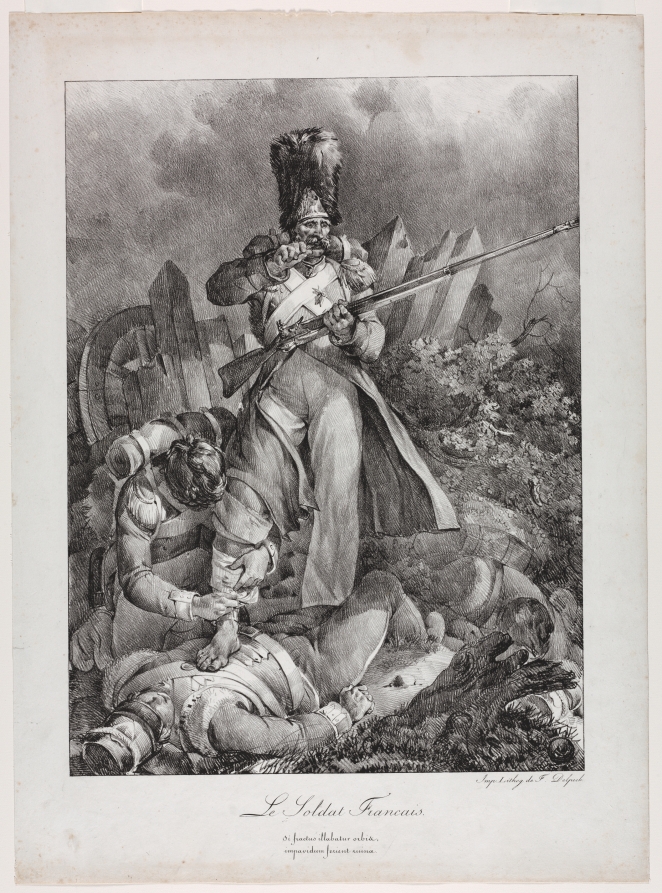
The French Soldier (Le Soldat français) (1818) is in the Cleveland Museum of Art collection. The museum's creator attribution is Nicolas Toussaint Charlet (French, 1792–1845); Delpech.
The work and its context
The museum's open-access catalogue describes the work:
Lithography was invented in 1798 by the German Aloys Senefelder. Although the technique was introduced in France in 1801, it was predominantly used for commercial ventures until 1815 when lithographic workshops—like that of François Delpech, who printed The French Soldier—were established in Paris. In 1814 Napoleon Bonaparte abdicated the throne and was banished to the island of Elba before being permanently exiled on Saint Helena. With the ensuing void in leadership, an idealized version of the Napoleonic era developed and Charlet was one of many artists who used art to glorify the French military. The French soldier depicted here, victorious against the prone Englishman, reloads his rifle and, although wounded, courageously continues to fight. The couplet from Horace beneath the scene comments that nothing can shatter the steadfastness of an honorable man.
Object facts
- Title: The French Soldier (Le Soldat français)
- Date: 1818
- Creator attribution: Nicolas Toussaint Charlet (French, 1792–1845); Delpech
- Culture: France, 19th century
- Type: Print
- Technique: lithograph
- Collection: PR - Lithograph
- Department: Prints
- Accession number: 2009.519
Collection credit
Gift of John Bonebrake
View the collection record
See the museum's photographs and full catalogue entry. Catalogue text is reproduced from the Cleveland Museum of Art's open-access data, with HTML formatting removed. This object and its supplied image are designated CC0.
Sources
More in Lifestyle
Keep reading