The game of wolf-running in Tabriz, from an Akbar-nama (Book of Akbar) (c. 1595–1600): Art, History and Details
The game of wolf-running in Tabriz, from an Akbar-nama (Book of Akbar) at the Cleveland Museum of Art: c. 1595–1600, Gum tempera, ink, and gold on paper. Explore the work's context, creator attribution and collection history.
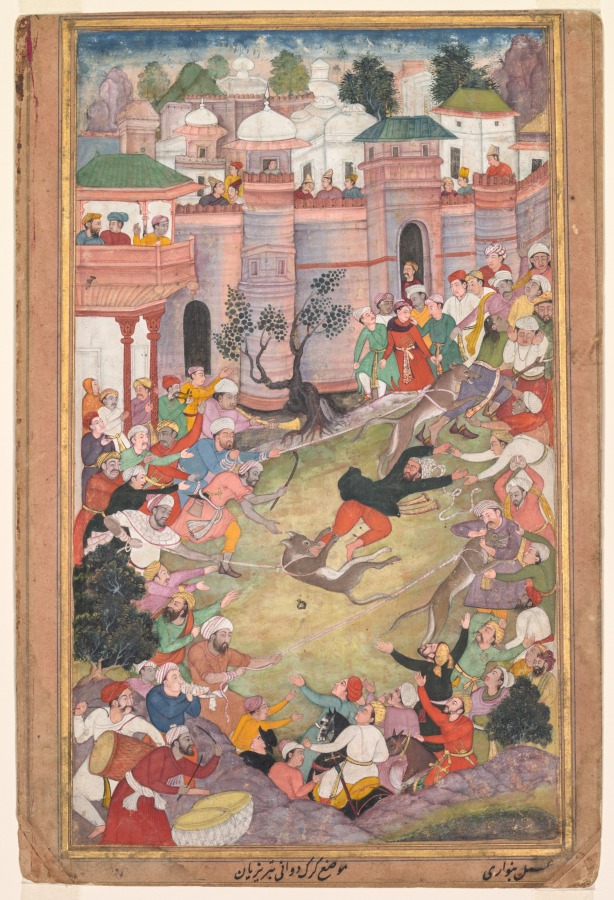
The game of wolf-running in Tabriz, from an Akbar-nama (Book of Akbar) (c. 1595–1600) is in the Cleveland Museum of Art collection. The museum's creator attribution is Banavari 1 (Indian, active 1550s-1590s).
The work and its context
The museum's open-access catalogue describes the work:
After four years of traveling in exile, fleeing Afghan forces, Humayun reached Tabriz, the glittering capital of the Safavid dynasty in northwestern Iran, here imaginatively rendered by the Indian artist. There the second Mughal emperor enjoyed warm hospitality extended by the shah of Iran, who called for a game of wolf-running for which the city was famous. Artists painting during the time of Akbar, late in his reign when historical subjects dominated, speculated as to how the game was played, based on eyewitness accounts. They gave the figures lively emotive expressions and gestures, and the dense crowding successfully conveys the pandemonium of the scene.
Object facts
- Title: The game of wolf-running in Tabriz, from an Akbar-nama (Book of Akbar)
- Date: c. 1595–1600
- Creator attribution: Banavari 1 (Indian, active 1550s-1590s)
- Type: Painting
- Technique: Gum tempera, ink, and gold on paper
- Dimensions: Page: 35.2 x 23.8 cm (13 7/8 x 9 3/8 in.)
- Collection: Indian Art
- Department: Indian and Southeast Asian Art
- Accession number: 2003.38
A detail from the museum
During extreme activities, turbans could come unwound and fall off.
Collection credit
Alma Kroeger Fund
Further reading listed by the museum
- "Art of Asia Acquired by North American Museums, 2003-2004." Archives of Asian Art 56 (2006): pp. 109-32.
View the collection record
See the museum's photographs and full catalogue entry. Catalogue text is reproduced from the Cleveland Museum of Art's open-access data, with HTML formatting removed. This object and its supplied image are designated CC0.
Sources
More in Lifestyle
Keep reading